
.jpeg)
Episode Highlights
- 00:00 : Introduction to Market Creation
- 01:01 : The Birth of Revenue Orchestration
- 04:24 : Identifying the Pain Points in Sales
- 07:01 : The Decision to Go All In
- 09:41 : Understanding the Infrastructure vs. Tooling
- 11:01 : Creating a New Category: Revenue Orchestration
- 16:31 : The AI Revolution and Its Impact
- 19:26 : Shifting to an AI-First Philosophy
- 24:35 : The Market's Acceptance of Revenue Orchestration
- 26:30 : Navigating Venture Funding and Market Needs
- 28:55 : Creating and Sustaining Market Dynamics
- 33:03 : The Evolution of Revenue Orchestration
- 37:13 : Building Community and Customer Evangelism
- 41:06 : Crafting a Playbook for Market Creation
- 44:09 : Future Directions and Market Adaptation
Ashley Wilson co-founded Momentum in 2020 with a conviction most founders couldn't articulate yet: that sales teams didn't need better tools, they needed the layer beneath them. What followed were three decisions that built a category from scratch.
Ashley and her co-founders saw that gap and built into it. They chose to build the infrastructure layer that connected the existing stack rather than compete within it, and that decision is where everything else in this story starts.
The difference between building a tool and building infrastructure
The earliest customers described Momentum as "what you'd get if Zapier and Troops had a baby." Not exactly a category-defining tagline, but embedded in that awkward description was the architecture of what Momentum was actually building.
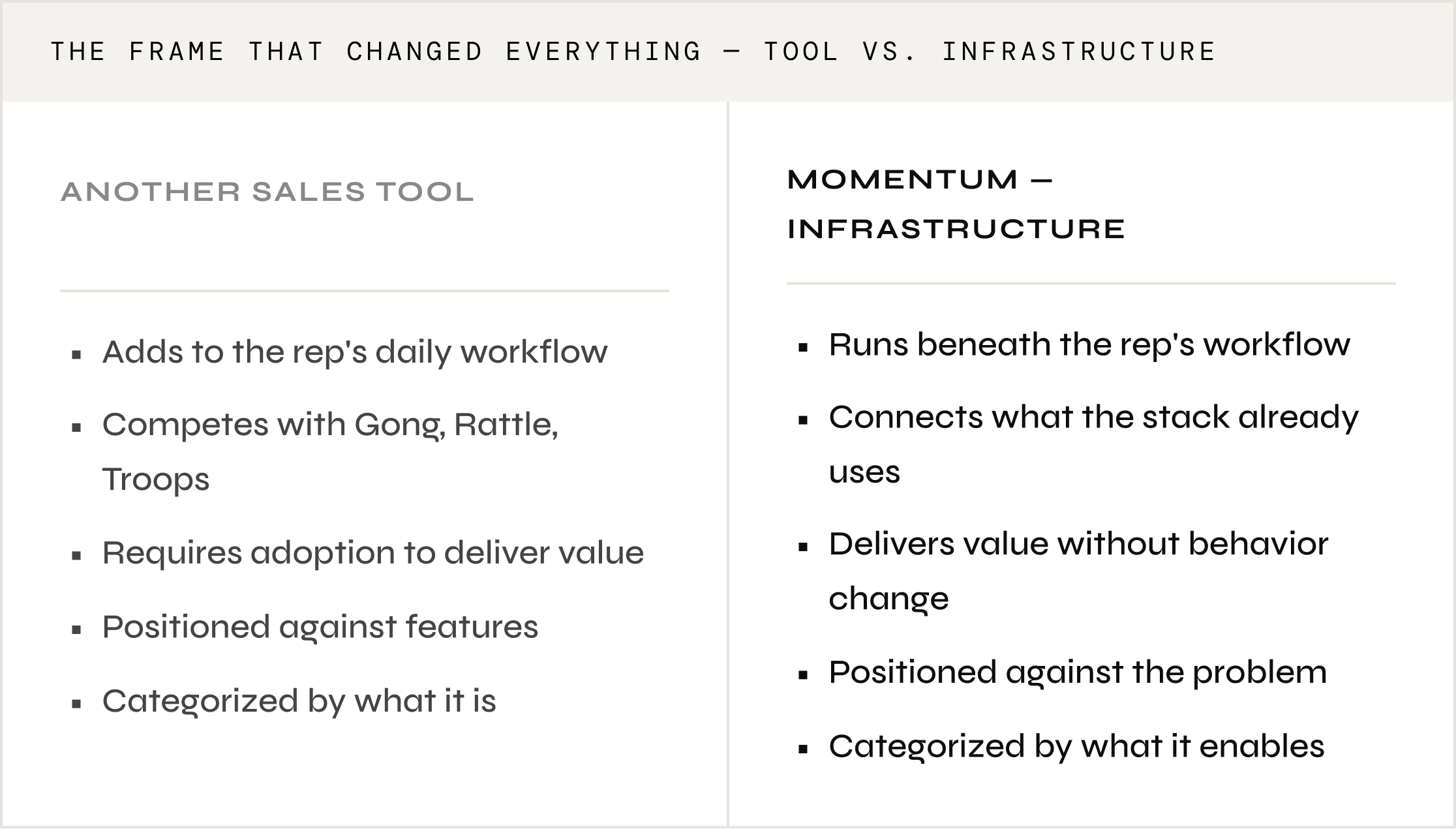
"We always viewed this as infrastructure versus tooling," Ashley told us.
The distinction is more than semantic. A tool adds to the rep's workload; infrastructure removes it by running automations in the background, updating Salesforce without anyone touching it, and routing approvals through Slack before the rep even knew they were needed. The word they eventually landed on for all of this wasn't chosen in a marketing session.
The language came from the market, and they had the conviction to claim it
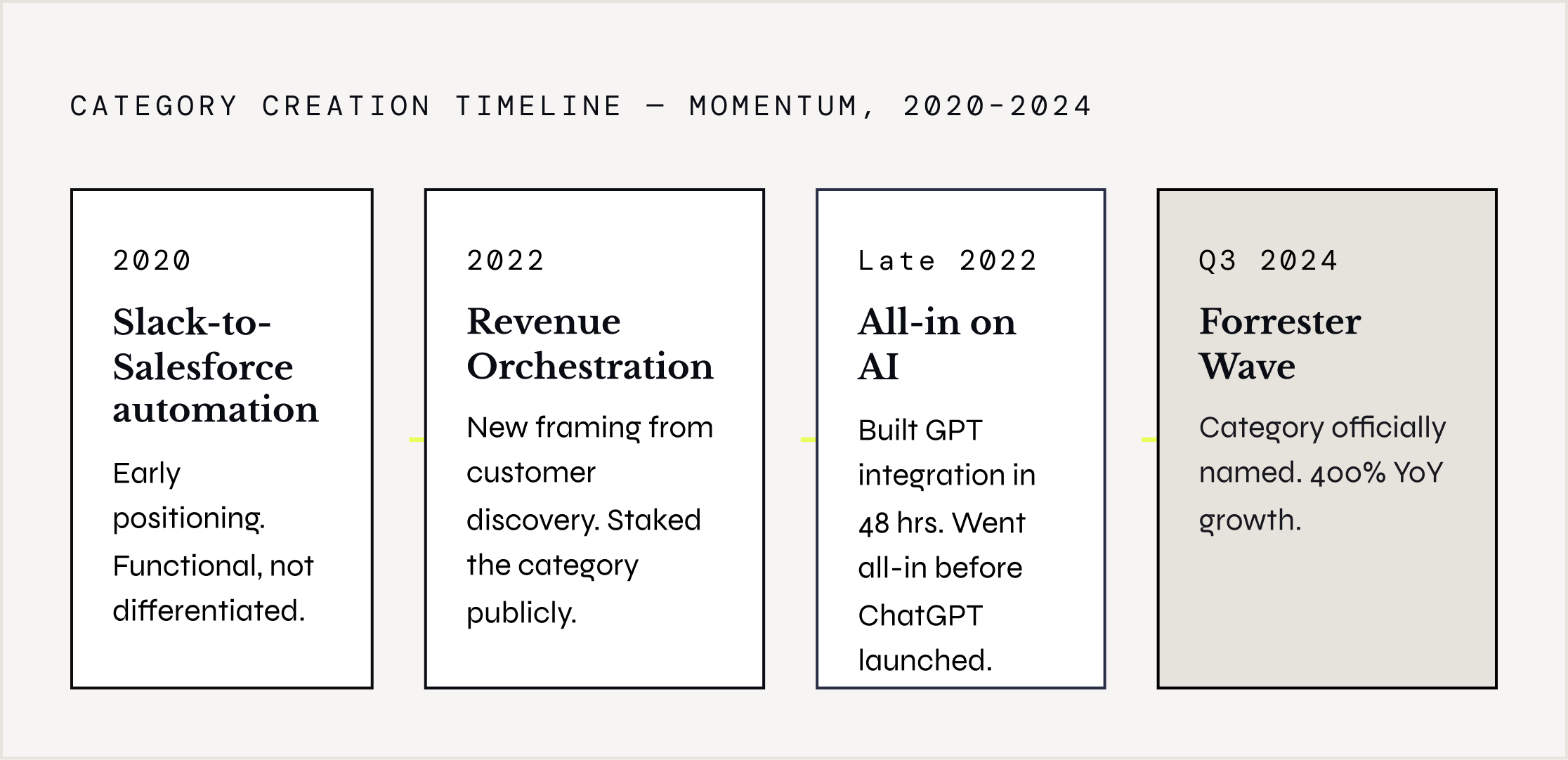
Momentum's first pitch deck called the product a "Slack-to-Salesforce automation platform." Functional, accurate, forgettable. The category name came later, and it came from listening.
Early advisors like Vandana Nehr, running rev ops at Dropbox, walked the team through what the function actually needed: not more tools, but a workflow engine that coordinated tools and did work on behalf of the team. From those conversations, the language started to sharpen.
"Automation" suggested replacing a task; "orchestration" suggested conducting, with multiple parts moving toward a unified outcome. They chose the word that carried the right weight, then committed to it publicly and held the line.
"You always want to be ahead and different. But sometimes in the product, you have to show value really quickly. AI made things a lot easier for us - it let us deliver value fast in a product that was technically deep."
- Ashley Wilson, Co-Founder & CEO, Momentum
Ashley's 4 non-negotiables for creating a market
Peter put her on the spot: if you had to write a market creation playbook, what are the three to five non-negotiables? Here's what she said.
01. Create brand early, even before you're ready
Pick a category and start talking about it publicly. You'll feel too early, and that discomfort is the signal. The feedback loop you get from being in the market always moves faster than the loop you get from thinking inside the company. Don't wait for the perfect positioning. Put something into the world and let the market sharpen it.
02. Make customer conversations a core part of the job, not a task on the list
Momentum still holds roadmap sessions with 40-50 top customers, not to present to them but to build with them. The category language that sticks doesn't come from a naming exercise. It comes from what customers say when they describe the problem in their own words. Ashley heard "momentum" in back-to-back calls. That's how the company got its name.
03. Get outside help sooner than feels necessary
Founders default to owning everything, but generic effort across all functions doesn't beat specific expertise where it matters most. Ashley hired content and social support early, plugging gaps she didn't have the time or inclination to fill herself.
04. Be willing to throw it out when the market shifts
In September 2022, an OpenAI executive told a room of founders that what they thought was coming in 10 years was coming much faster. Momentum's CTO had a GPT integration running within 48 hours. They went all-in on AI for go-to-market before ChatGPT launched publicly. If they hadn't taken that leap, the 400% growth year in 2024 almost certainly doesn't happen.
Momentum has a Slack channel with every single customer.
The channel isn't for support; it's about staying permanently close to the people using the product. "It goes really far in SaaS — turns out people like good humans," Ashley said. That closeness produced the organic evangelism no campaign could replicate.
Kyle Norton, CRO of Owner.com, became a customer and started talking about Momentum publicly not because of a referral incentive but because the product and the team earned it.
You can't manufacture that kind of advocacy. But you can build the conditions for it. Stay one Slack message away from every customer. Make them feel like co-builders, not users. When the product earns it, they'll do the market creation work for you.
That's what market creation actually looks like at the ground level: no launch, no category announcement, just a product good enough and a relationship close enough that your customers build the market alongside you, before Forrester ever puts a name on it.
Follow Ashley's work at momentum.io and on LinkedIn.