
.jpeg)
Episode Highlights:
- 00:46 : The Vision behind Clarify
- 03:07 : The Challenge of Competing with Giants
- 06:20 : Innovating Beyond the Status Quo
- 09:13 : The Decision to Leave Stability for Entrepreneurship
- 12:05 : Timing the Market
- 14:55 : Defining Autonomous CRM
- 17:57 : Building a Community around Autonomous CRM
- 21:02 : Understanding Customer Needs: the Key to Success
- 26:23 : Building Relationships with Early Customers
- 31:20 : The Role of Community in Product-led Growth
- 36:15 : Innovating Beyond Traditional SaaS Models
- 42:15 : Navigating Market Creation Challenges
- 47:37 : Lessons from Founders and Market Creators
Patrick Thompson, co-founder of Clarify, walked away from a comfortable life at Amplitude, second kid on the way, because he saw a $280B category that hadn't had a genuine rethink in decades. Two years in, his customers are posting on LinkedIn that they haven't updated their CRM in three months. Not by accident. By design.
This is the first edition of Create the Market — conversations with founders who aren't competing for existing demand. They're building demand that didn't exist before.
Patrick Thompson is doing that inside one of the most entrenched categories in software. Here's what the playbook actually looks like from the inside.
Most founders run from red oceans. Patrick ran toward one.
The conventional wisdom in startups is to find a niche with no entrenched competition. Patrick went the other direction, straight at a category owned by two companies worth a combined $280 billion.
His reasoning was simple: the category was universally despised and hadn't fundamentally changed since before AI existed. Incumbents were bolting features onto legacy infrastructure and calling it transformation. The window to rethink the whole thing from first principles was open. And it wouldn't stay open forever.
"If we'd left Amplitude six months later, we probably would have missed the boat," he told us. "You have to come up with conviction yourself on whether to pull out of something safe and comfortable to do something that's the opposite of that."
He and his co-founder left seven figures in unvested compensation to go find out.
Autonomous vs. assistive. This is the line that matters.
Every major CRM right now is building co-pilot AI — assistants you still prompt, manage, and interact with. The human stays in the loop for every step.
Patrick calls what Clarify built ambient AI: the system running silently in the background, doing the work before you think to ask for it. Call transcript analyzed. Deal record updated.
Relationship history summarized. Prospects flagged. All of it without a single data entry from the rep.
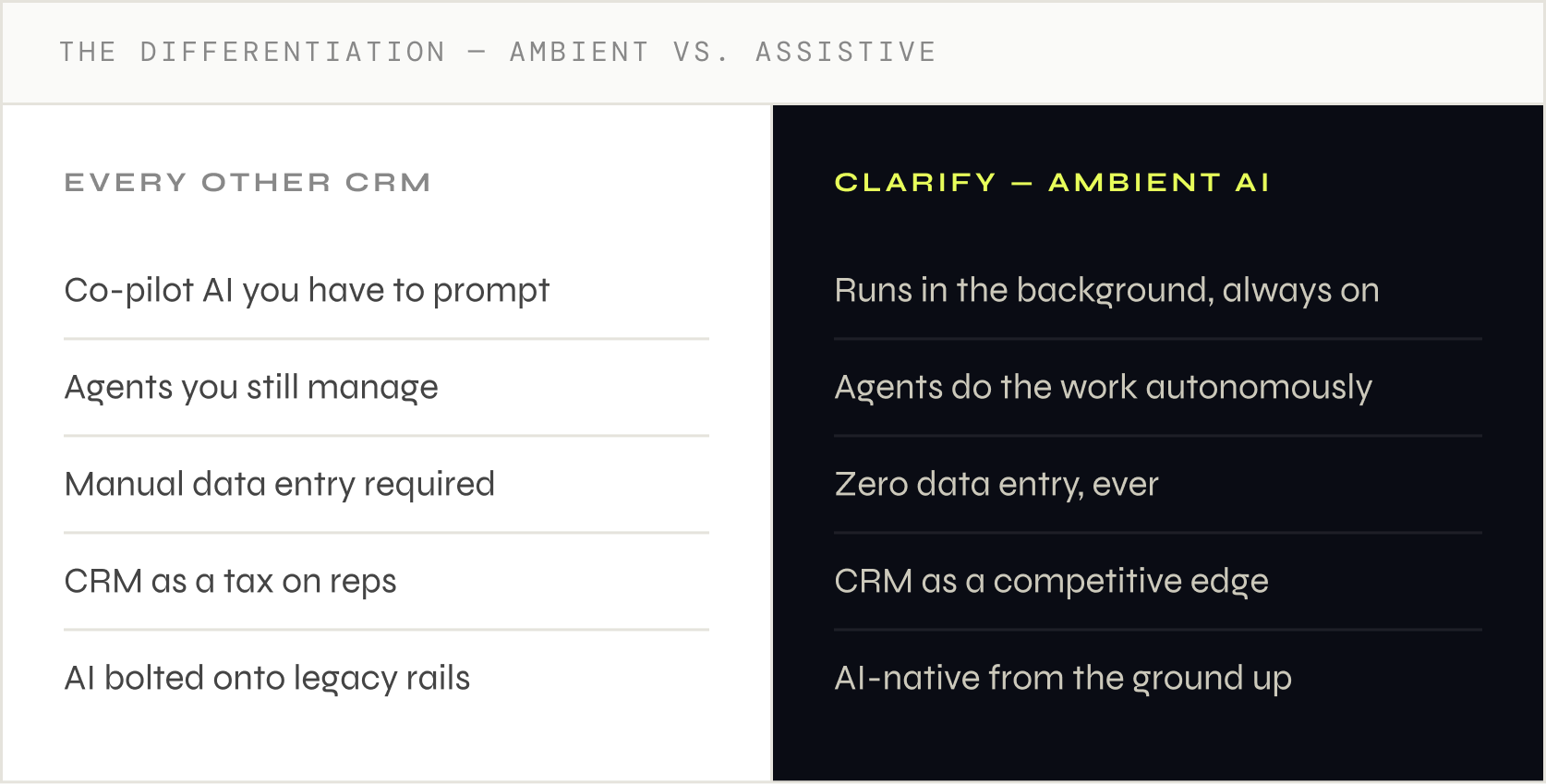
"The number one pain with CRMs is they're always out of date," Patrick said. "The rep never fills in the data. It's a tax your manager forces on you. No one has ever built a CRM designed for the end-rep experience. We've eliminated the CRM tax."
While the industry relies on “feature improvements”, Clarify leads with category redefinition, built on solving the root cause rather than the symptom.
Patrick's playbook — what founders can actually steal
Patrick has created two markets. The patterns are consistent enough to be a framework. Here's what he's actually doing, broken into the decisions that matter.
1. On Finding the Right Category
• Find categories with pent-up pain and stalled innovation. Frustration is fuel for a movement. CRM is universally hated, that’s not a warning, it’s an invitation.
• Ask the root-cause question. Are you solving the symptom or the underlying problem? Patrick built Iteratively solving a symptom. With Clarify, he went back to solve the actual cause.
• Know which game you’re playing. Blue ocean: build a wedge, embrace-extend-extinguish. Red ocean: be 10x better at one thing, or commit to the full platform. These are different strategies, don’t confuse them.
2. On Naming the Category
• Listen before you name. “Autonomous CRM” came from customer discovery calls, not a marketing session. Patrick heard customers using the word first, then claimed it.
• Anchor new to familiar. “Autonomous CRM” works because CRM is already understood. The modifier does the disruption. “Unified go-to-market platform” would have required educating buyers from scratch.
• Standardize relentlessly once you have the word. Investor updates, collateral, sales calls, repeat until it permeates. Patrick was initially resistant. He let the market decide, and it did.
3. On ICP and Early Customers
• Go narrow enough to build a differentiated experience. Clarify’s initial ICP: VC-backed B2B SaaS, under 50 people, some level of product-market fit. They understood this buyer deeply because they came from that world.
• Your first 10 customers make or break your category. They define the product language, the positioning, and the social proof. Don’t spread before you’ve nailed one segment.
• Qualify for belief, not budget. True believers become the movement. Prospects looking for a cheaper Salesforce become churn.
4. On Timing and Commitment
• Time technology shifts the way you time markets. GPT-3’s trajectory made the window visible from inside Amplitude. Patrick moved before it closed.
• First to resonance beats first to market. Apple didn’t build the first MP3 player, or the first touchscreen phone. They built the ones people actually wanted.
• Be ready to leave money on the table when the window opens. Patrick left $7M. The Loom founder left eight figures. The window doesn’t wait for your vest to cliff.
5. Customer discovery isn't research. It's a gut biome.
Patrick runs more than 10 customer calls a week and has done so since launch. Before Clarify went public, he'd onboarded 50 active customers, held bi-weekly calls with all of them, and kept a shared Slack channel open around the clock.
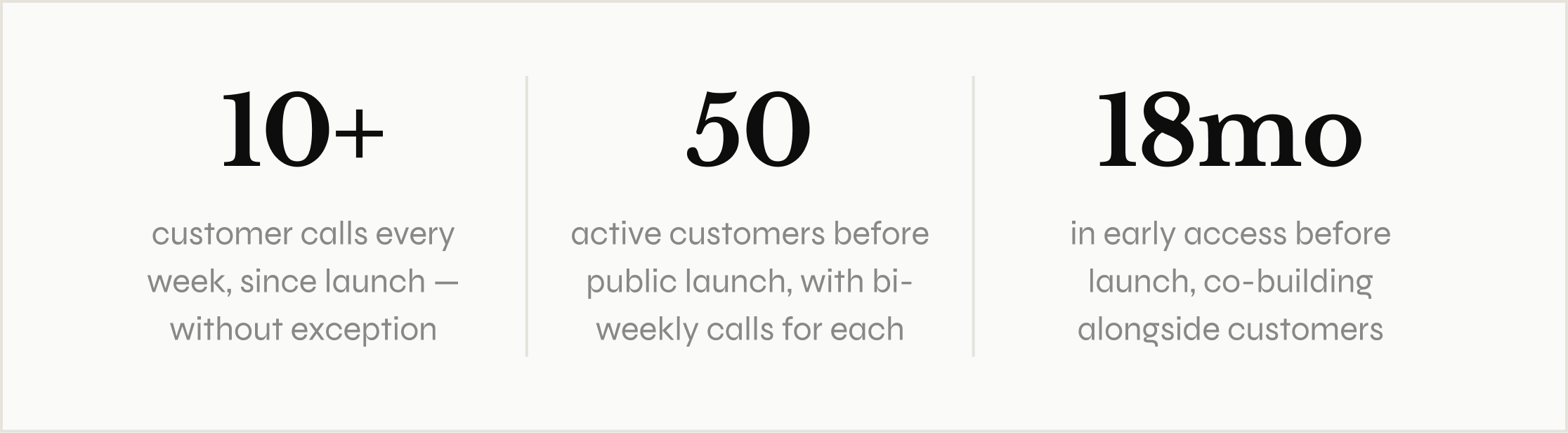
He doesn't call this research. He calls it fine-tuning his gut biome, a database of conversations he can draw on to make faster decisions as the company scales.
"Product-market fit is not guaranteed. I've been at organizations that had it and then the market shifted from under them. The constant connection to the customer is something I never want to give up."
• Treat early customers as partners, not users — Clarify didn't charge pilot customers because they were co-building, not consuming
• Build feedback channels that don't scale away from you — shared Slack, bi-weekly calls, quarterly business reviews
• Use discovery to validate AND invalidate assumptions — the goal isn't confirmation, it's accuracy
• Never let PLG distance you from who you're actually building for — that's where product-market fit quietly dies
You can name the market. The market decides if the name fits.
Patrick was genuinely resistant to the word "autonomous." He thought it was too big, too abstract. He asked his team: "Can everybody even spell it?"
Then a customer posted on LinkedIn that they hadn't touched their CRM in three months — not as a complaint, but as a boast. Then another. Then another. They were using his word before he'd officially made it the company's word.
Resonance can't be forced. But it can absolutely be built for.
Follow Patrick's work at Clarify.ai and on Substack at Founder Therapy.
LinkedIn: @PatrickTo10.