
.jpeg)
Episode Highlights
- 00:05 Creating New Markets: The Journey Begins
- 01:51 From Competitors to Co-Founders: The Birth of Attention
- 07:07 Identifying Pain Points: The Shift in Sales Dynamics
- 12:20 Iterating on Feedback: The Evolution of Product Strategy
- 21:05 AI Native vs. Legacy Tools: A New Era in Sales Intelligence
- 25:46 Building a Vision: The Future of Sales Intelligence
- 26:15 Understanding Customer Needs and AI Integration
- 28:11 Competing with Incumbents: Strategies for Success
- 33:25 Rapid Growth and Market Shifts
- 38:16 Creating a New Market: The AI Native Advantage
- 42:15 Founder's Playbook: Building a Successful Market Presence
- 45:08 Future Vision: Autonomous Systems and Business Growth
Anis Bennaceur built an AI-native sales intelligence platform that made a category king irrelevant — not by outspending them, but by building for an era Gong wasn't designed for.
Him and his now-co-founder Matias ran rival companies for years. They called it a war. Then they grabbed coffee in Tribeca, realized they were both exhausted by the creative tech space, and walked out as partners in an entirely new company.
That company — Attention — competes directly with Gong ($500M+ raised) and Chorus (acquired by Zoom Info). Not by matching their budgets. By making their architecture obsolete.
What follows is the full playbook: how they found the real product, how they named a new category, how they built audience before they had a sales team, and the one hiring rule that hasn't changed since day one.
They built the wrong thing first. Here's what changed.
Attention's original product was real-time coaching — AI-powered battle cards that surfaced guidance mid-call. It sounded obvious. Every sales leader said they wanted better coaching. Anis spent eight months building it.
Then they shipped it. Reps stopped responding to emails. The head of enablement said they hated the product. The battle cards arrived four seconds too late. The content lacked deal context. Asking a rep to split attention between a customer and a screen was more distraction than tool.
Eight months. Back to zero. But instead of a full pivot, Anis kept listening — and almost accidentally found the real product.
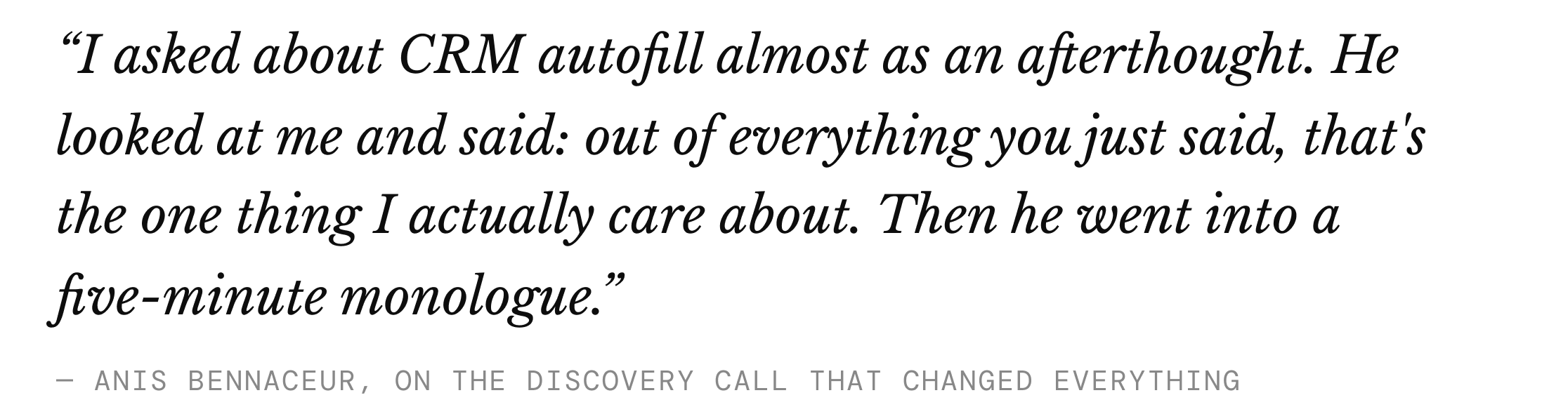
An AE at Auth0 said his company would pay serious money to have Salesforce filled automatically. Best sellers are artists or scientists — they're not paid to do admin. The absence of a solution was its own argument. That's a painkiller.
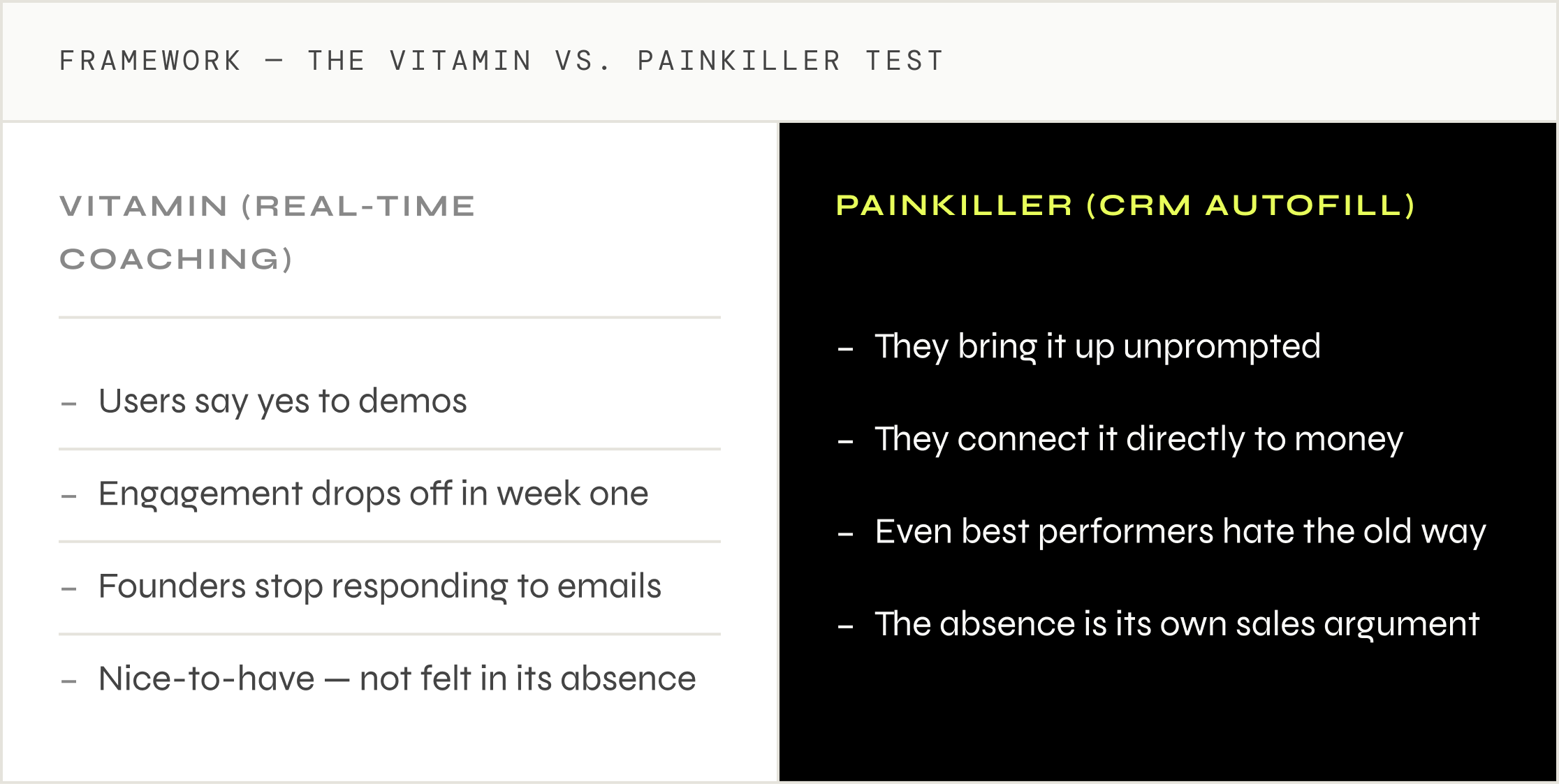
The real signal wasn't feature demand — it was embarrassment about a task that shouldn't exist. Find what your users are quietly ashamed they still do manually. That's where the market is.
Category Creation
"AI-native" isn't a tagline. It's an architectural truth.
When Gong was built, conversation intelligence meant one thing: record the call, surface a summary, show dashboards. That architecture made sense for the era. The product's epicenter was the recording itself.
Attention's epicenter is different at the foundation level. Anis calls it the brain — a context graph that ingests calls, emails, Slack, CRM data, and the full revenue motion. The brain generates intelligence. That intelligence drives autonomous action.The system learns from outcomes and improves continuously.
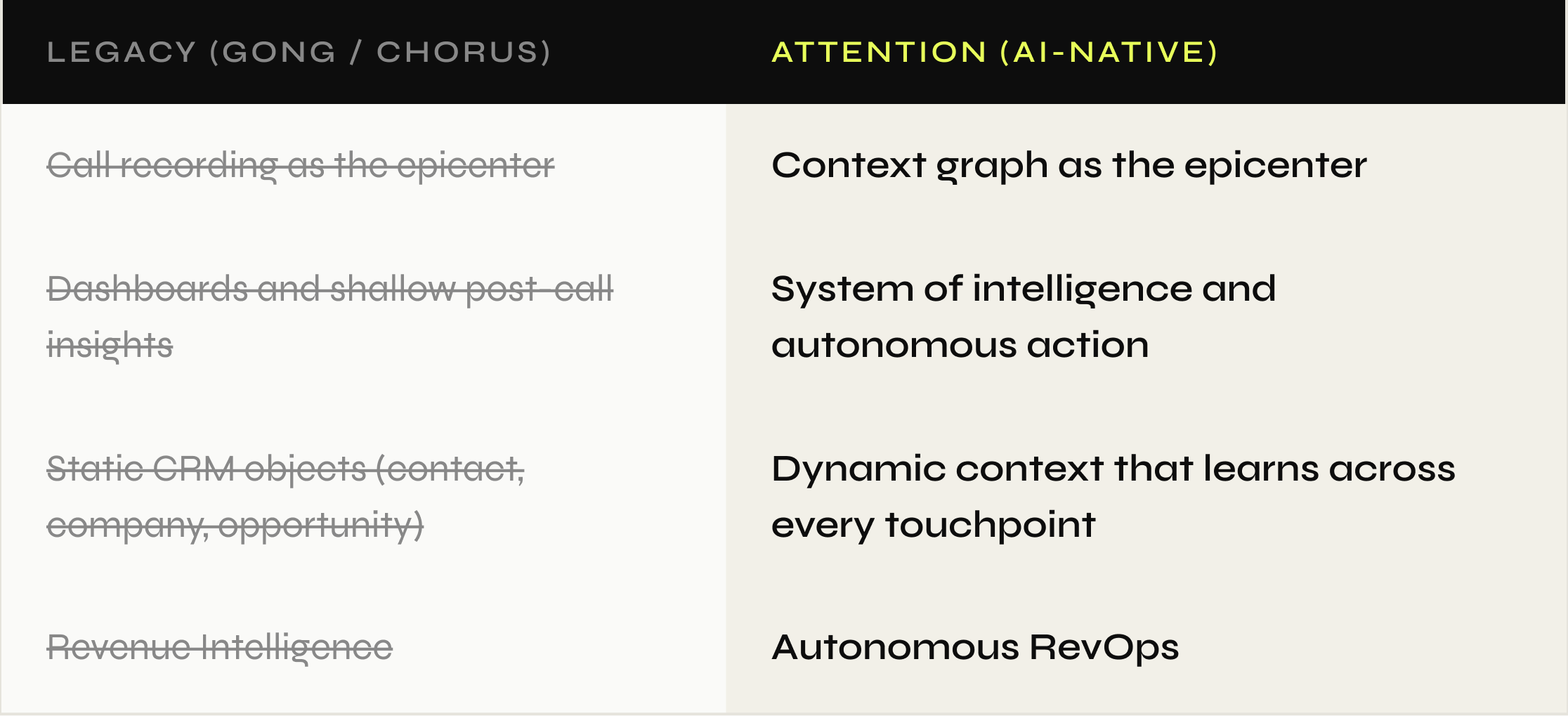
To ship what Attention does natively, Gong would have to rip out their entire product. They have thousands of clients on that architecture and can't do it overnight. The result — a Frankenstein product built in the wrong era — is precisely the opening Attention walked through.

This is what it looks like to create a market rather than compete for one. You don't claim a feature advantage. You make the category argument: the previous generation was built for the previous era. We started where they ended.
70% inbound before they had a sales team. Here's how.
While Attention was in stealth, Anis spent roughly a year systematically building an audience of sales leaders on LinkedIn — not by publishing content, but by adding them and sending a single unedited message: people call what we're building mind-blowing. I just want brutal feedback. Thirty minutes?
He was getting three qualified meetings per day from the same message. When they came out of stealth in early 2023 — riding the ChatGPT wave — his LinkedIn post drove tens of thousands of impressions and converted into 70% inbound in the early pipeline.
- Be where your buyers live — all day, every day. LinkedIn is where Anis'sbuyers spend time. He posts constantly: client wins, employee milestones,founder learnings. Positive energy signals that something real is working. Buyersorbit what's working.
- Never name the incumbent. He has never once mentioned Gong in hiscontent. "We're not building conversation intelligence. We're buildingautonomous RevOps." Own the lane. Name your category, not theirs.
- Get inside your clients' Slack. Anis and Matias are still in Slack channelswith every client. Speed of iteration, speed of response — being reachable — thatvelocity is what separates the companies that compound. Clients should feellike a teammate, not a vendor.
- Start smaller than you think, then grow ACV up. Their first customerswere seed-stage companies with two or three reps — not the enterprise logosthey'd been talking to in stealth. The market showed them where to start. Theylistened, then grew upmarket from proof.
- Use the product yourself, every single day. Anis was running 7–10founder sales calls daily and using Attention to write every follow-up email.When Tim Lee (former Sequoia partner) heard this, he said: "That's when youknow you're onto something." Dogfooding isn't a tactic. It's conviction.
Hell yes or hell no. No exceptions.
If you're not willing to fight — to pay whatever it takes — to get someone onto your team, the answer is no.
Anis asks candidates about their childhoods, their wildest dreams, whether they want to be founders. He looks for people on a quest for excellence, not people looking for a job.
He'll tell them directly: I want you to start a company in two years. That honesty attractsbuilders, not passengers. And when you hire one B-player, A-players feel it — and leave. He'd rather have one superstar than five almost-there candidates, every time.
The principle extends to product decisions too. The team closed their first six-figure deal in August 2024. Within months, six-figure deals were happening every month. Then $300–400K deals. Then seven-figure deals. The acceleration isn't because of themarket — it's because every person on the team is an owner who can operate at that level.
Follow Anis's work at attention.com and on LinkedIn: @AnisBennaceur.