
.jpeg)
A step-by-step guide to building the layer that makes GTM more powerful: from category naming through audience engineering, signal tracking, and turning customers into advocates your competitors cannot buy.

GTM is not your strategy. It never was.
GTM is the execution layer, it captures demand that already exists. The strategy is what you build before GTM runs. It determines whether you are on the shortlist at all. Most operators skip it. So CAC climbs, pipeline stalls, and nobody can explain why the sequences aren't working.
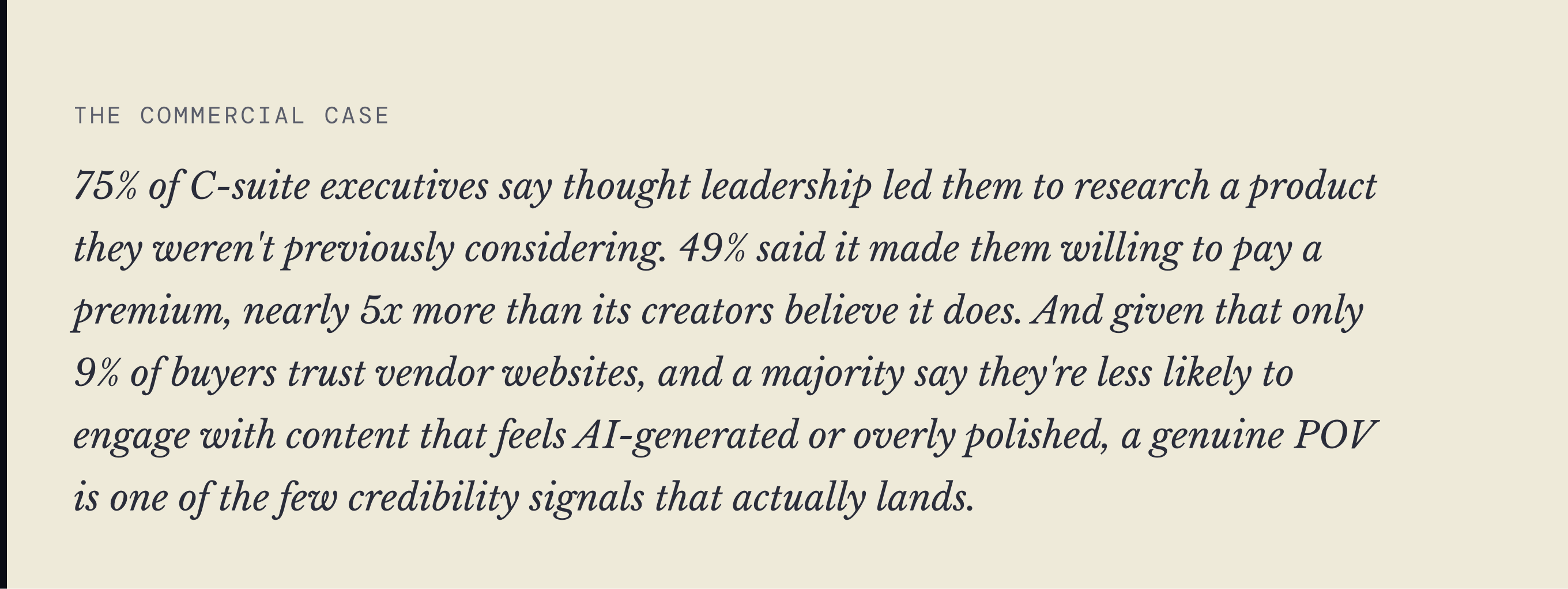
Here is what the data actually says about how buying decisions get made.Buyers are roughly 70% through their journey before they ever talk tosales, and most already have a preferred vendor when they finally reach out. Across studies, 70 to 90% of B2B buyers say peer recommendations and word-of-mouth are the top influence on which vendors they even consider — not your website, not your ads, not your sequences.
Only 9% of buyers consider vendor websites a trust worthy source. And buyers spend maybe 5 to 6% of their total purchase journey with any individual sales rep. The other 94 to 95% happens somewhere you can't see, can't pixel, and can't sequence into.
Create the Market (CTM) is the layer that runs underneath GTM. It has three components: Audience Engineering builds owned distribution. Point of View development builds intellectual authority. Category Narrative sets evaluation criteria in your favor — so that when a buyer does their research, they are using your vocabulary to judge every competitor in the room.
This is the practitioner's guide. Six steps, in order, with everything you need to execute each one.
How to use this guide
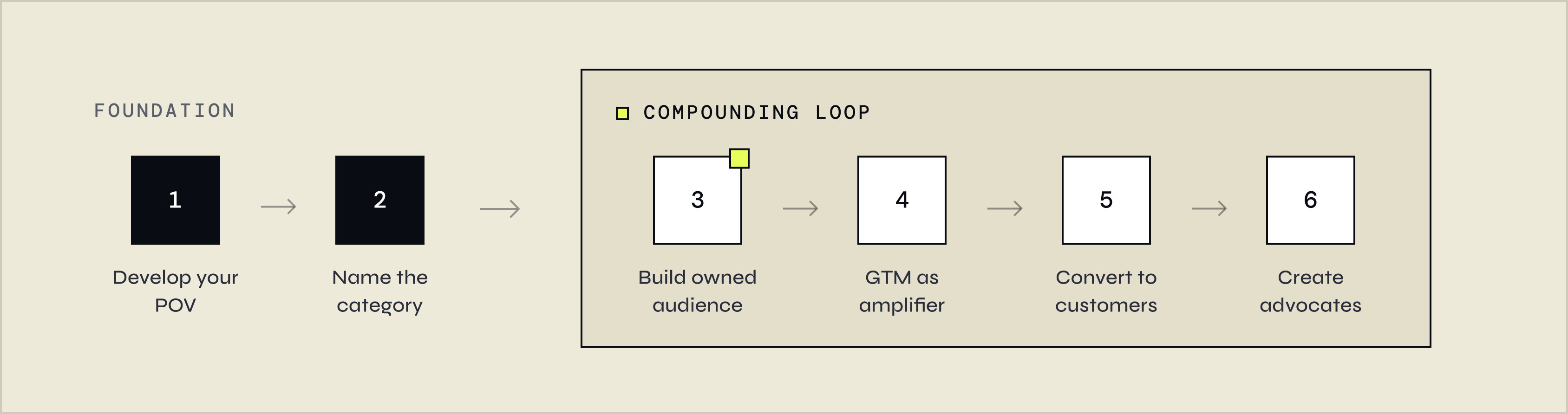
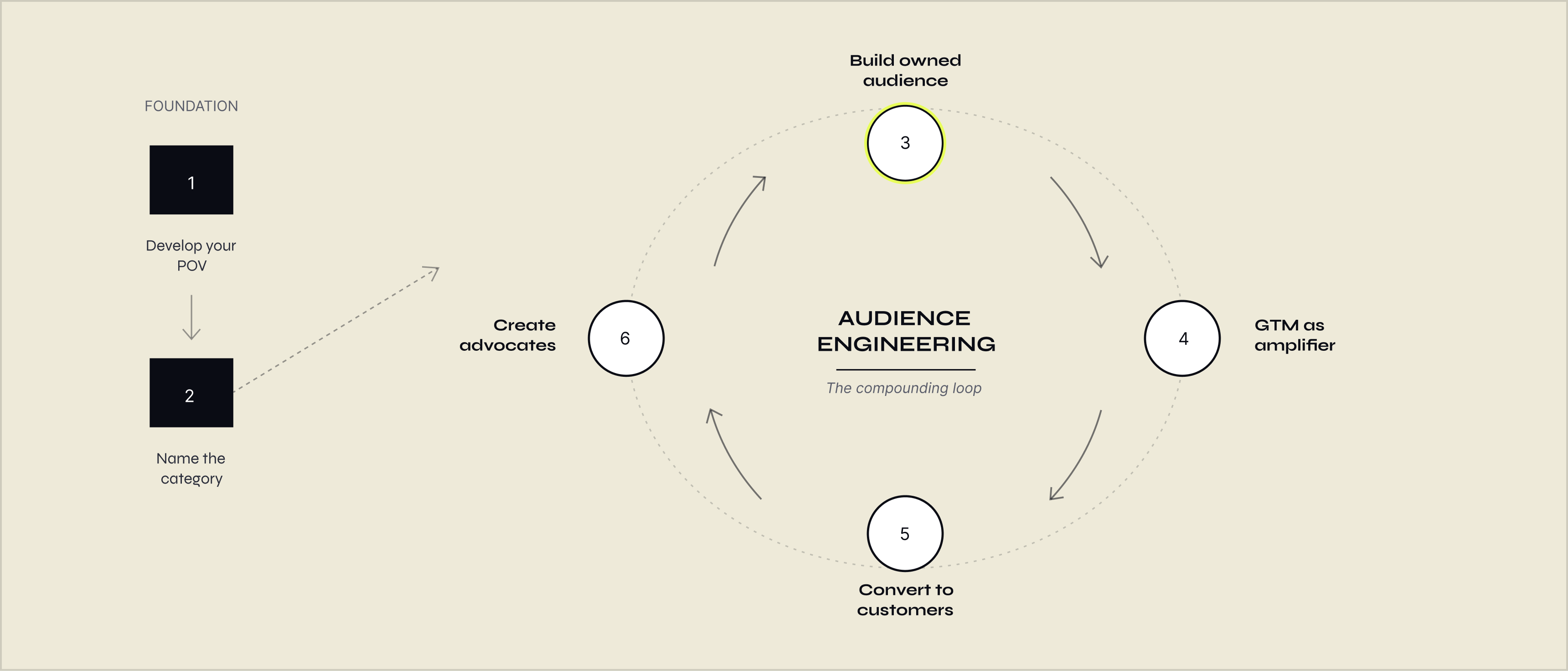
Steps 1 and 2 are the foundation: done once and done right. Steps 3 through 6 form a compounding loop that never stops. Each cycle tightens targeting, improves content resonance, and compounds the asset. The loop gets more efficient every time it runs.
Foundation: Done once. The intellectual infrastructure everything else runs on. You cannot shortcut it.
Foundation: think
Step 1 — Develop your point of view
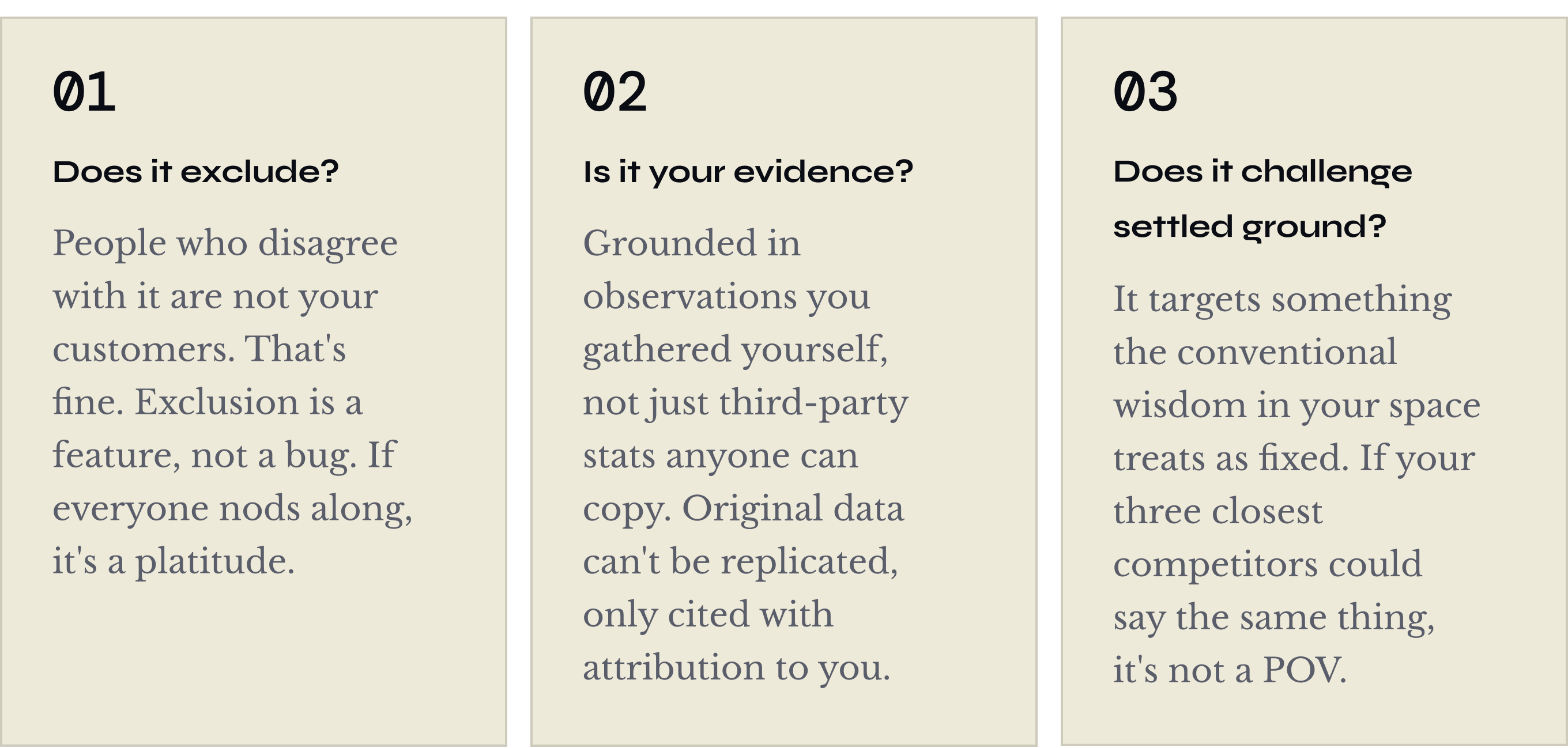
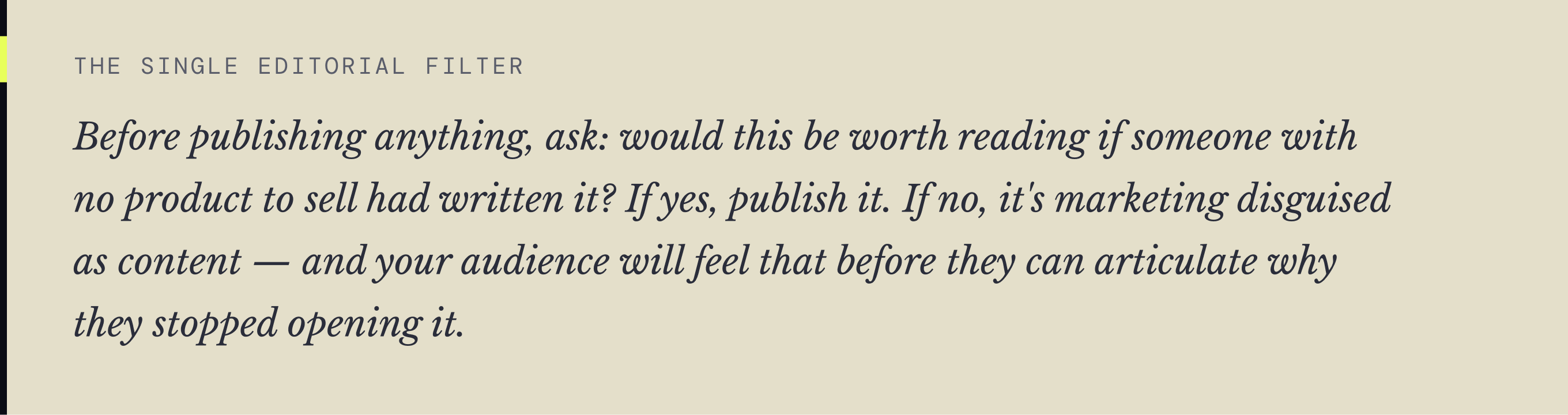
Most operators publish thinking their entire market agrees with. That is not a point of view. It is noise with a byline. The content that builds a shortlist position is specific enough that the wrong buyer stops reading and the right one forwards it to their team.
The content that builds a shortlist position is specific enough that the wrong buyer stops reading and the right one forwards it to their team. If everyone nods along, you haven't written a POV — you've written a platitude with a logo on it.
Differentiation is a product concept. POV is a market concept. You can have a genuinely differentiated product and still have no POV. If you're describing what you do better than competitors instead of explaining how the world should work differently, you're competing on features, not framing.
Three tests for a strong POV
How to build it
- Write one sentence starting with: "Everyone in [your category] believes X. We think that's wrong because..." That sentence is your POV seed.
- Interview 10 existing customers. Ask what they believed before they found you, and what they believe now. The delta is your POV.
- Run a 30-day test: one sharp, problem-framed post per day. Track whoreplies vs. who scrolls. Replies are your POV signal — they tell you who feels this acutely.
- Run original research — a 20-question survey to 100 ICP contacts. Publish the findings even if they complicate your narrative. Data you generated cannot be copied.
POV failure modes
- ✗ "We need better tooling in this space" — nobody disagrees, nobody cares
- ✗ "We do X faster than Y": differentiation, not a POV
- ✗ Three competitors could publish the exact same statement
- ✔ "GTM is structurally broken because it optimizes for 17% of the buying journey": specific, challengeable, excludes the wrong buyer
- ✔ "Adding more SDRs makes the problem worse, not better": challenges settled convention and will make some people angry
Foundation: frame
Step 2 — Name the category problem before the market has language for it
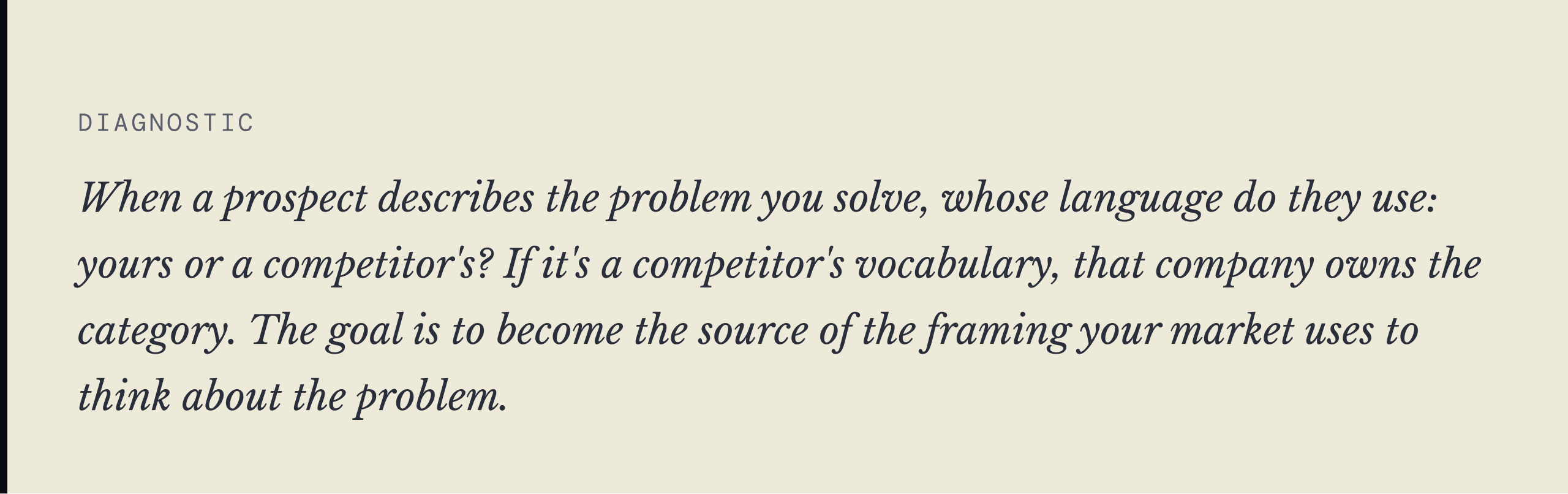
The company that names the problem sets the evaluation criteria for everyone who follows. Every buyer who adopts that framing evaluates competitors through your lens. That is not a content advantage. It is a structural one.
Every buyer who adopts your framing evaluates competitors through your lens. That is not a content advantage. It is a structural one. Gong named "Revenue Intelligence" — every competitor now gets evaluated against a standard Gong set. HubSpot named "Inbound Marketing" — anyone who agreed with the problem framing was already pre-sold before they saw a demo.
The excavation process
- Find the problem beneath the problem: the structural reason your customer's current approach fails them, stated in terms true regardless ofwhether your product exists.
- Ask customers: "How do you describe this problem to peers who don't use usyet?" Listen for the language they use before they know your vocabulary. That gap is the category.
- Write: "The problem with [existing category name] is..." and pressure-test it with people who should disagree strongly.
- Test: if your category name could apply to three different products, it's not specific enough. If removing your product makes the name meaningless, you've found it.
Category naming tests
- ✔ Buyers who adopt the frame evaluate competitors through your lens automatically
- ✔ The name makes the category feel inevitable: not invented by a marketing team
- ✔ People who genuinely disagree with the framing would not buy from you anyway
- ✘ The name describes what you do, not what's broken in the world
- ✘ It could belong to a feature, not a market shift
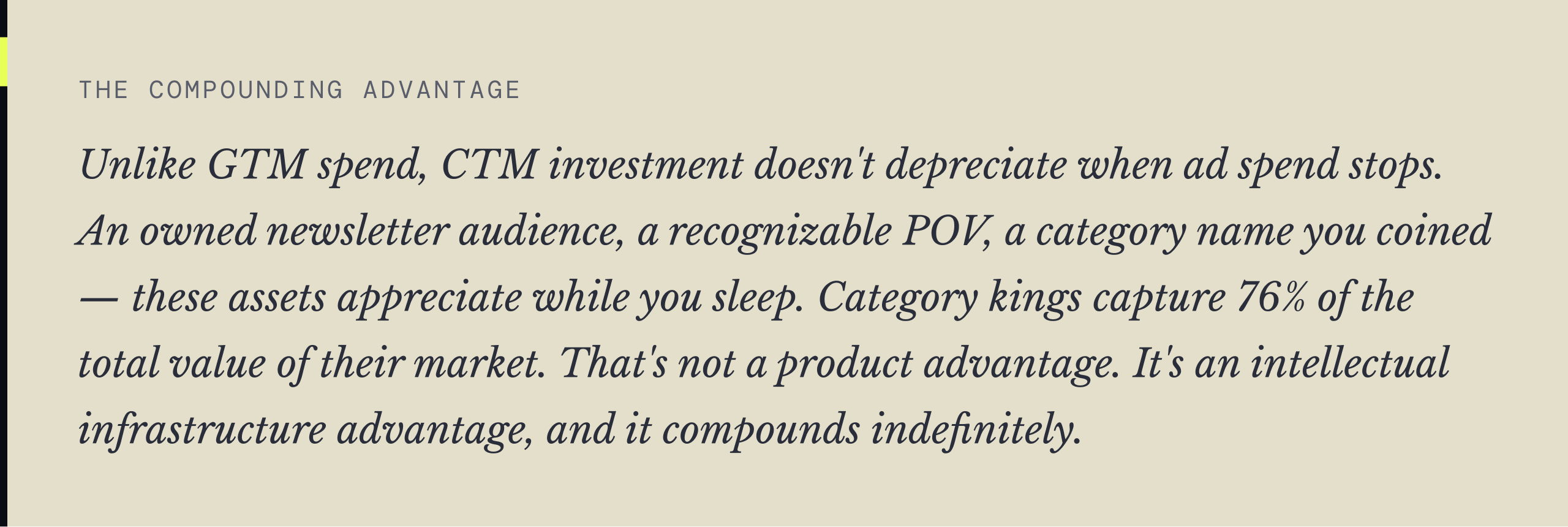
"The category creator sets the evaluation criteria — not just the product. When HubSpot coined 'inbound marketing,' every buyer who adopted that framing was already using HubSpot's vocabulary to think about their problem. That's not a product advantage. It's an intellectual infrastructure advantage. And it compounds indefinitely."
Compounding loop: audience engineering
Steps 3 to 6 run continuously. Each cycle tightens targeting, improves content resonance, and compounds the asset. The loop restarts every timea customer becomes an advocate who seeds the next acquisition cycle. Itnever stops: it just gets more efficient.
Loop: build
Step 3 — Build your owned audience before you need the pipeline it produces
The operators generating consistent inbound built their audience months before they needed it. The best time to build your audience was the day the company was founded. The second best time is today.
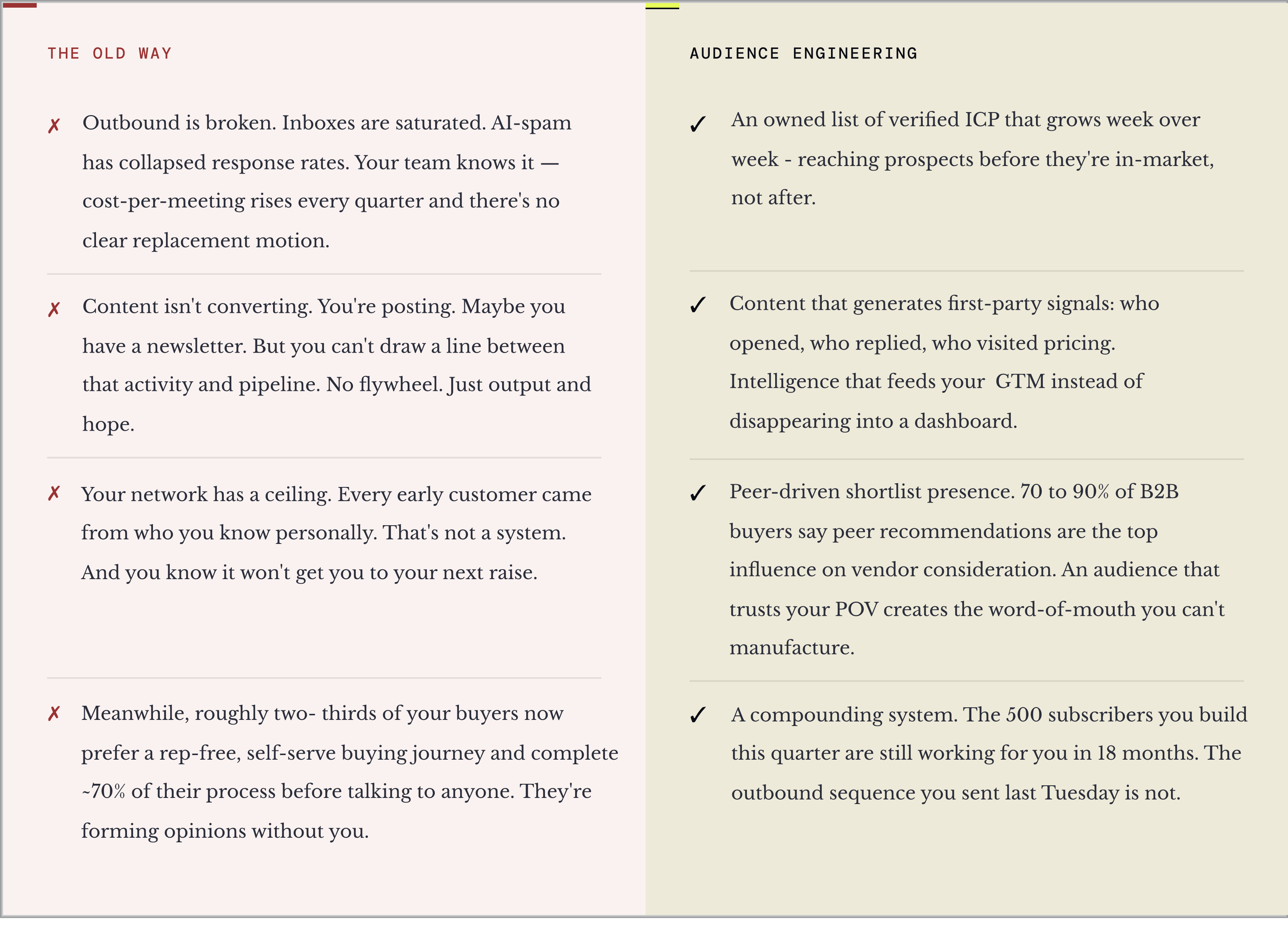
The old way — why you're here
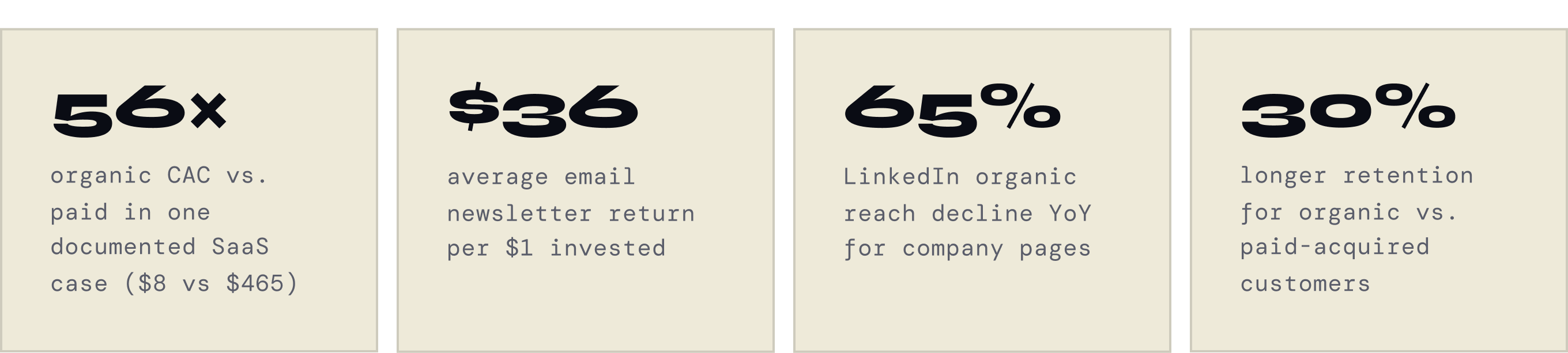
The economics
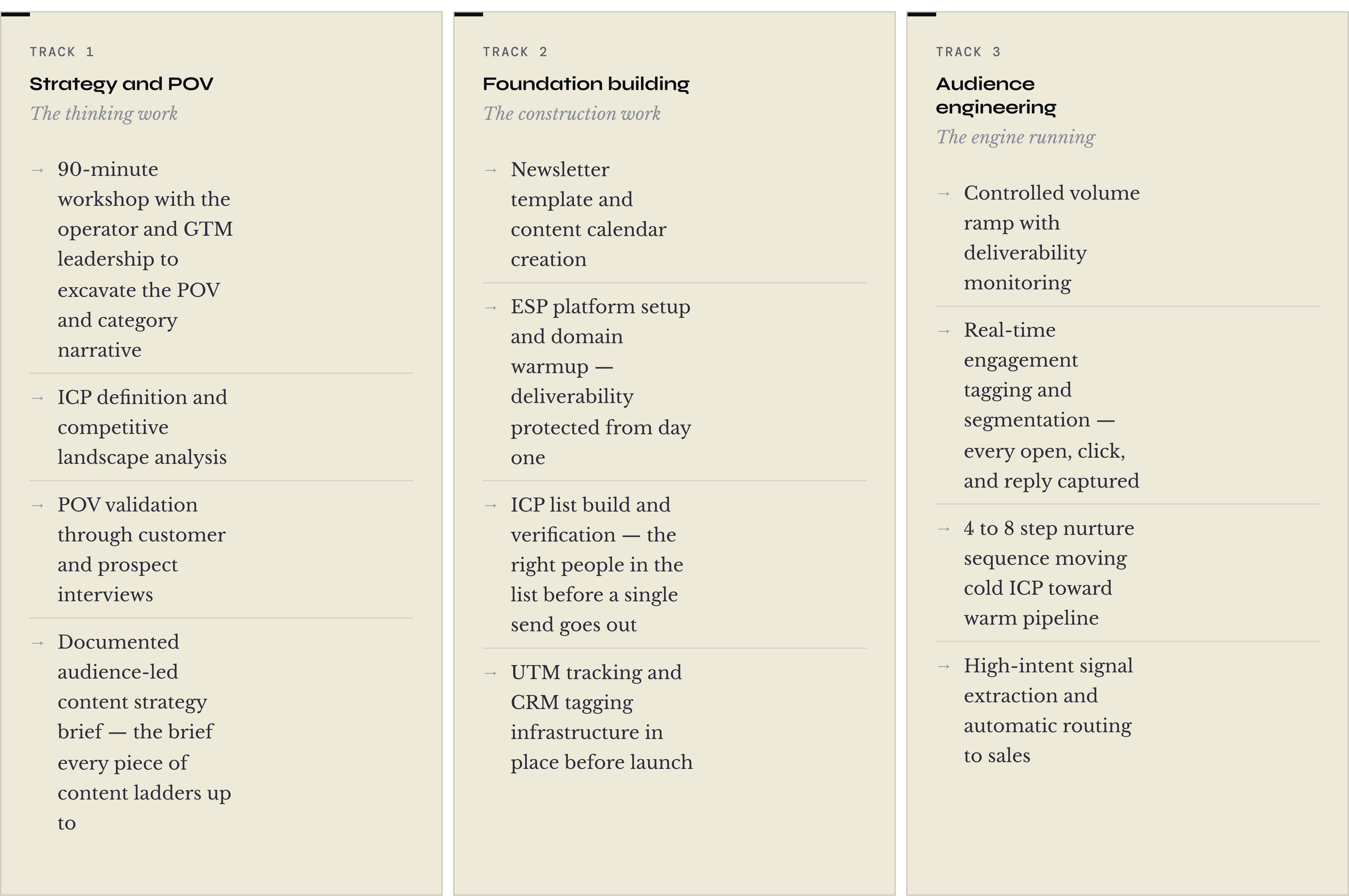
How it actually works — three tracks built in parallel
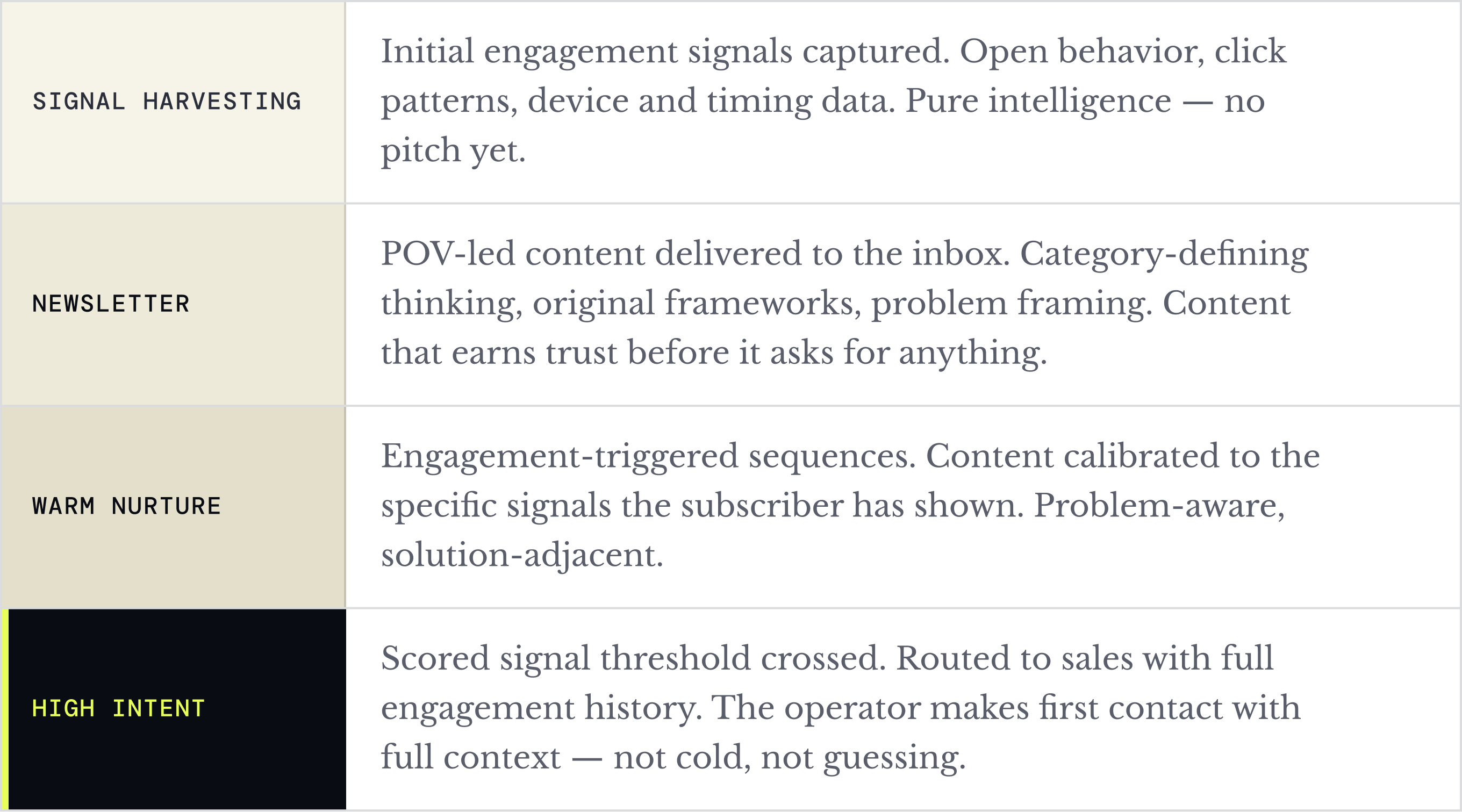
Content is what you say. Audience Engineering is the infrastructure that makes sure the right people hear it — and turns their engagement into pipeline signals your sales team can act on. It runs on three tracks simultaneously.
The funnel — from cold ICP to warm pipeline, continuously
New verified ICP enters the list every week. Each cohort moves through a defined sequence. The system doesn't wait for pipeline — it builds the conditions that make pipeline inevitable.
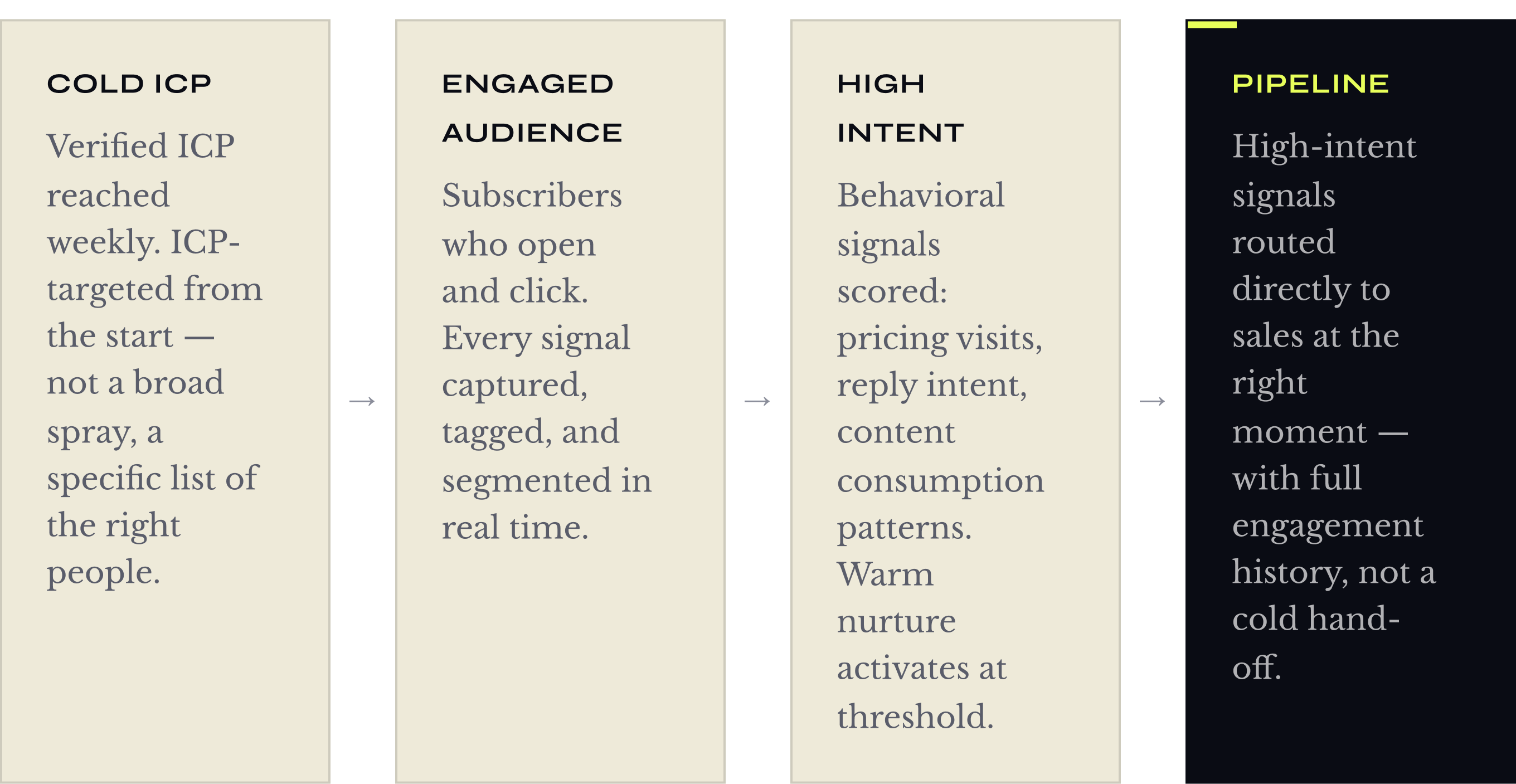
The cohort journey — signal harvesting to high intent
Each new cohort of ICP subscribers moves through the same sequence.Multiple cohorts run in parallel every week, so while one cohort is reaching high intent, a new one is just entering signal harvesting. The engine never idles — each cycle makes the next one sharper.
Loop — amplify
Step 4 — Use GTM as the amplifier, not the engine
Once the first three are working, outbound reaches people who already recognize the name. Sales conversations start with credibility already in the room. You areno longer paying to introduce yourself.
Sales conversations start with credibility already in the room. GTM becomes what it was always meant to be: acceleration, not ignition. The sequence matters. CTM builds the market, GTM captures it. Most companies run them in reverse and wonder why CAC keeps climbing every quarter.
But the relationship isn't one-directional. GTM doesn't just benefit from audience — it feeds it. Every sales call, every prospect interview, every objection handled on a discovery call is raw material that makes the next piece of content sharper, more specific, and more resonant with the exact buyer you're trying to reach.
The CTM → GTM architecture
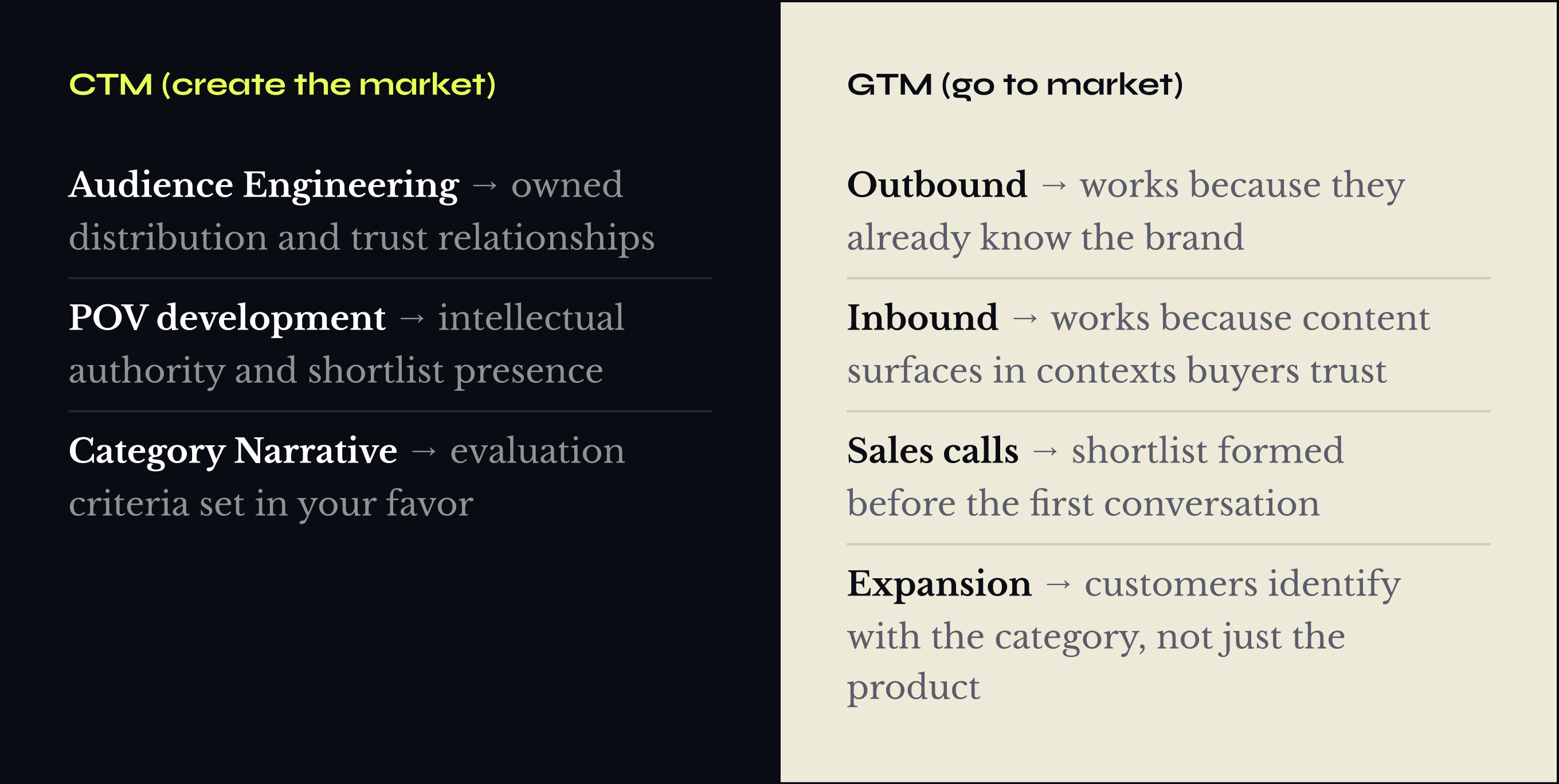
GTM as intelligence source — the feedback that sharpens everything
Your prospects and customers are the most accurate signal you have about what your market actually believes, fears, and wants to hear. Most companies let that intelligence die in a CRM note or a Slack message. The ones building durable audiences pipe it directly into their content engine.
Call recordings: Mine Gong, Chorus, or your own recordings for the exact language prospects use when describing the problem before they've heard your framing. That language belongs in your newsletter subject lines, your LinkedIn posts, and your category narrative — verbatim, or close to it. When a prospect says "we're drowning in activity but I can't explain what's actually working," that sentence is worth more than any positioning exercise.
Prospect interviews: A 20-minute "no-pitch" conversation with someone who fits your ICP but hasn't bought yet is one of the highest-leverage content investments you can make. Ask what they've tried, what failed, what they tell their board. Every answer is a content brief.
Customer stories as content: The moment a customer articulates their before/after — the way they described their problem before finding you, versus how they think about it now — you have a POV proof point that no generic thought leadership can match. Turn those moments into newsletter editions, LinkedIn posts, and case study frameworks.
Objections as editotial calendar: Every recurring objection in your pipeline is a topic your audience doesn't have enough context on yet. "We tried content before and it didn't work" is an article. "We need pipeline now,not in six months" is an article. Address them in public beforethey come up in the sales call.
Anecdotes over abstractions: A specific story from a real conversation — "I was on a call last week and a VP of Sales told me his team had sent 4,000 emails that month and booked three meetings" — creates more trust in a newsletter than any stat you can cite. Use the intelligence from GTM to make the content feel lived-in.
Finding and engineering access to the ICP
- Map where your ICP already spends attention: specific LinkedIn communities, podcasts they guest on, newsletters they forward, events they speak at. Go where they already are.
- Build verified ICP lists before the newsletter launches — not after. Enrich by firmographic and technographic criteria, then verify deliverability.Infrastructure before the engine turns on.
- ICP self-selection test: 30 days of problem-framed content, tracking who replies vs. who scrolls. Repliers are your real ICP. Update targeting and Anti-ICP accordingly.
- Use three-dimensional targeting: persona depth (operational anxieties, not just titles), account context (firmographic tiering — Tier 1 accounts get deep custom content), and stage awareness (awareness content frames the problem, decision content proves ROI — never conflate them).
What changes when CTM is live
- Outbound response rates improve — prospects already recognize the brand, so you're not cold
- Inbound improves — 32% of B2B buyers now discover thought leadership through GenAI tools; your POV surface area is what gets synthesized
- Sales cycles compress — the shortlist was formed before the first call; you're validating, not introducing
- Content gets sharper — every sales conversation feeds the editorial engine,so each quarter the content is more specific and more resonant than the last
Loop — convert
Step 5 — Convert audience into customers
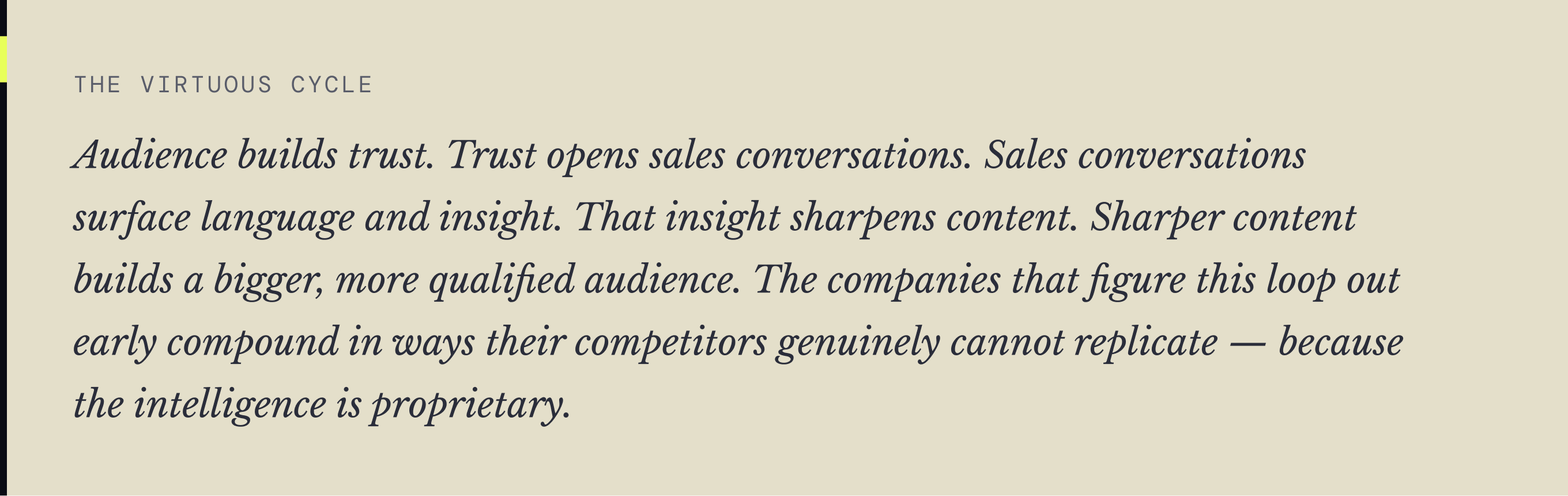
The operators generating consistent inbound aren't selling to strangers. They're closing people who have been reading their newsletter for six months, who forwarded it to their team, who already believe in the problem before the first call.That is not a sales motion. That is what an owned audience does to a pipeline.
That is not a sales motion. That is what an owned audience does to a pipeline. The mechanism is first-party signal data — behavioral evidence from your own list that tells you exactly who is moving toward a buying decision, what problem they're focused on, and when to reach out. No third-party intent tool required. Your audience tells you.
Consider what you're up against without it. Buyers spend roughly 5 to 6% of their total purchase journey with any individual sales rep. Nearly 80% of allB2B content sharing happens in dark social — Slack channels, private DMs, email forwards, WhatsApp groups — channels you can't see, can't attribute, and can't interrupt. The buyers who end up on your shortlist made that decision in a conversation you were never part of. First-party signal data is how you find the ones who are getting close, before they go dark.
Every open, click, reply, and page visit is a data point. Individually they're noise. In aggregate and sequence, they're the clearest purchase-intent signal available in B2B — because it comes from people who already chose to hear from you, rather than someone who stumbled onto your retargeting pixel.
The first-party signal stack — what to track and why it matters
Email opens (topic clustering): Someone who opens every edition about pipeline efficiency and ignores everything about brand is telling you what problem keeps them up at night. Segment by topic engagement, not just open rate. That segmentation shapes every outreach you send them.
Click-through patterns: A click on a pricing-related link is a different signal than a click ona how-to article. Map click behavior to intent stages. When the same person clicks pricing content twice in a week, that's a commercial trigger — not a metric to note and forget.
Direct reply to newsletter: The single highest-signal behavior in B2B. Someone who hits reply has crossed a threshold that 99% of subscribers never cross. That person should hear from the operator or founder within 24 hours — not a sequence, a person.
Repeat page visits: UTM-tagged links in your newsletter let you track which subscribers visit your pricing page, product pages, or case studies. Two visits to pricing in seven days is a commercial signal. Three is a hand-raise.
Content forwarding: A subscriber who forwards your newsletter to a colleague has just done your sales development work for you. Track forwards via unique per-subscriber links. That second contact enters your list pre-qualified by peer recommendation.
Event attendance (not registration): Anyone can register for a webinar. Showing up and stayingfor 45 minutes signals real intent. Attendance, Q&Aparticipation, and post-event content engagement are all distinct signal tiers.
Signal → conversation mapping
DO'S: High-intent signal cluster (reply + pricing visit + topic alignment): personal operator or founder outreach, same week, referencing the specific content they engaged with
DO'S: Mid-intent signal (repeated opens on a specific topic): invitation to a relevant office hours session or community discussion — value first, no pitch
DO'S: Early signal (consistent opens, no clicks yet): deepen the nurture — send the next piece in the sequence that advances the problem framing they responded to
DON'TS: Do not route every engaged subscriber to a demo form — the progression from content to conversation must feel earned, not automated
Nurture sequence structure (4 to 8 steps)
1 - 3 > Deliver on the promise — the exact value you said they'd get when they subscribed. No pitch. Build trust first.
4 - 6 > Deepen the POV and introduce the category problem with original data. Help them see the world differently.
7 - 8 > Soft invitation to engage further — office hours, community, discovery conversation. Framed as access and value, not a sales call.
CRM integration — make audience signals visible to sales
- Tag which Magnet brought each contact into the list — the entry point shapes what they need next
- Log topic engagement clusters: which editions they opened, which links they clicked, which problem areas they return to repeatedly
- Flag defined high-intent signal sequences as CRM activities — not just email open metrics in an ESP dashboard
- Feed closed-won signal patterns back to content: which engagement sequences correlated with deals? That's your next quarter's editorial calendar.
Loop — compound
Step 6 — Turn your customer audience into the advocates your competitors cannot buy
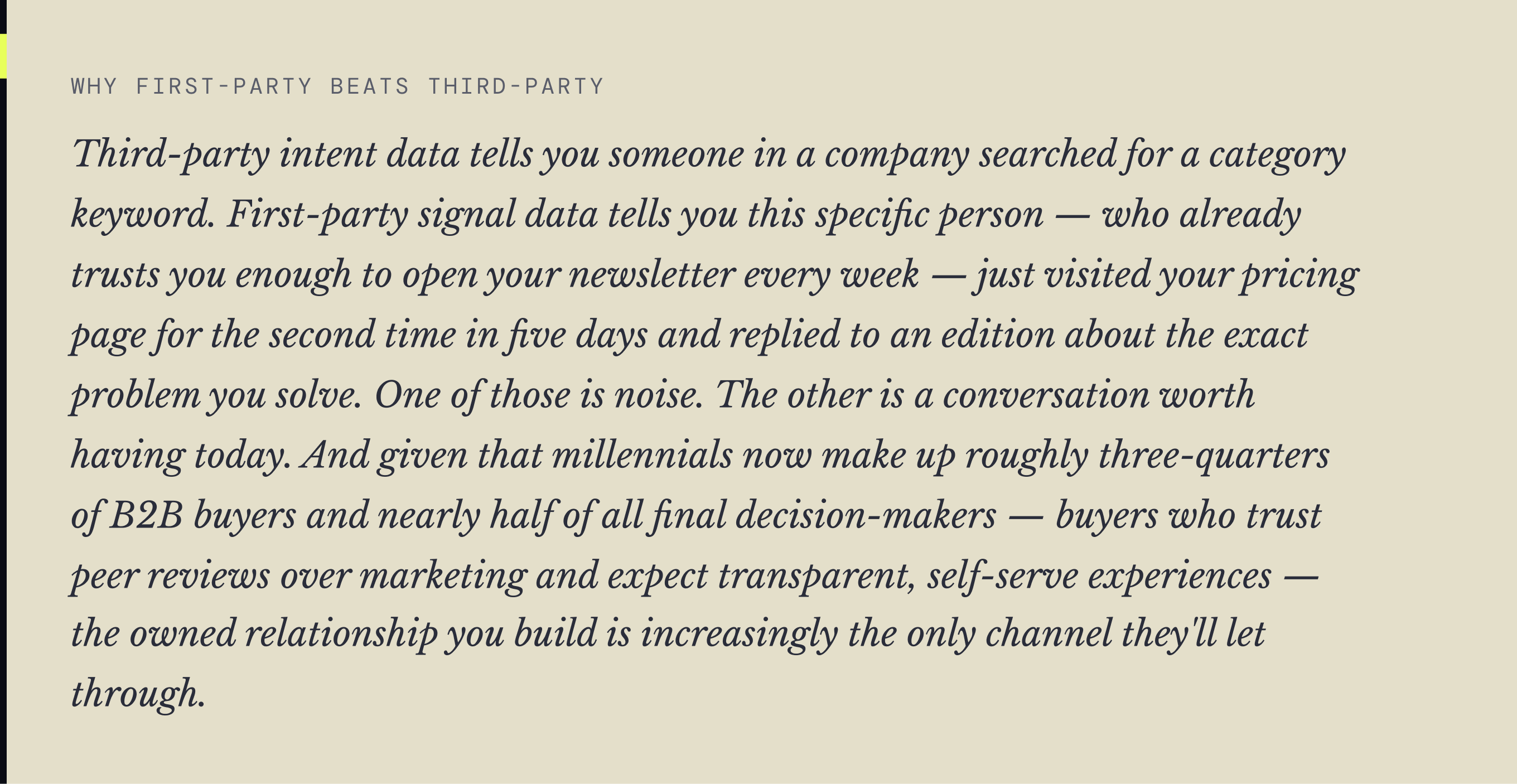
Paid reach stops the moment spend stops. A customer audience that believes in your point of view recruits for you continuously. The referral from a customer who forwarded your newsletter costs nothing and converts better than any sequence you will ever write.
The referral from a customer who forwarded your newsletter to their team costs nothing and converts better than any sequence you will ever write. By the time buyers talk to sales, most have already ranked their shortlist — and in recent studies, the vendor ranked first wins roughly 80% of the time. That shortlist was formed in peer conversations you weren't in. Your customers are either seeding those conversations or they're not, and what they say is outside your control unless you've built the relationship that earns it.
What turns customers into advocates
- They came through the audience — they already believed in the problem before the first call. That belief transfers directly to recommendation.
- They identify with the category, not just the product. "I use X" vs. "I believe in how X sees this problem" — the second person recruits for you without being asked.
- You continue to publish content worth forwarding after they become customers. The relationship doesn't end at close — that's when the compounding begins.
- You give them the language to explain what you do to peers. The category framing, the vocabulary, the POV. You arm them for the conversation they're already having at the next conference.
How the loop restarts at Step 3
- Customer success stories seed the next Surface cycle — case studies, guest posts, podcast appearances with borrowed credibility
- Customer language sharpens the category narrative — they say the POV back to you in ways that clarify and extend it
- Customer referrals enter the audience pre-qualified — their peer vouched for the POV before the first touchpoint
- Customer data generates original research — the next Magnet asset that compounds subscriber growth in the next cycle
Measurement
What to track before pipeline moves
Pipeline is the lagging indicator. If you only measure it, you'll kill the engine that's making it work before it has time to compound.
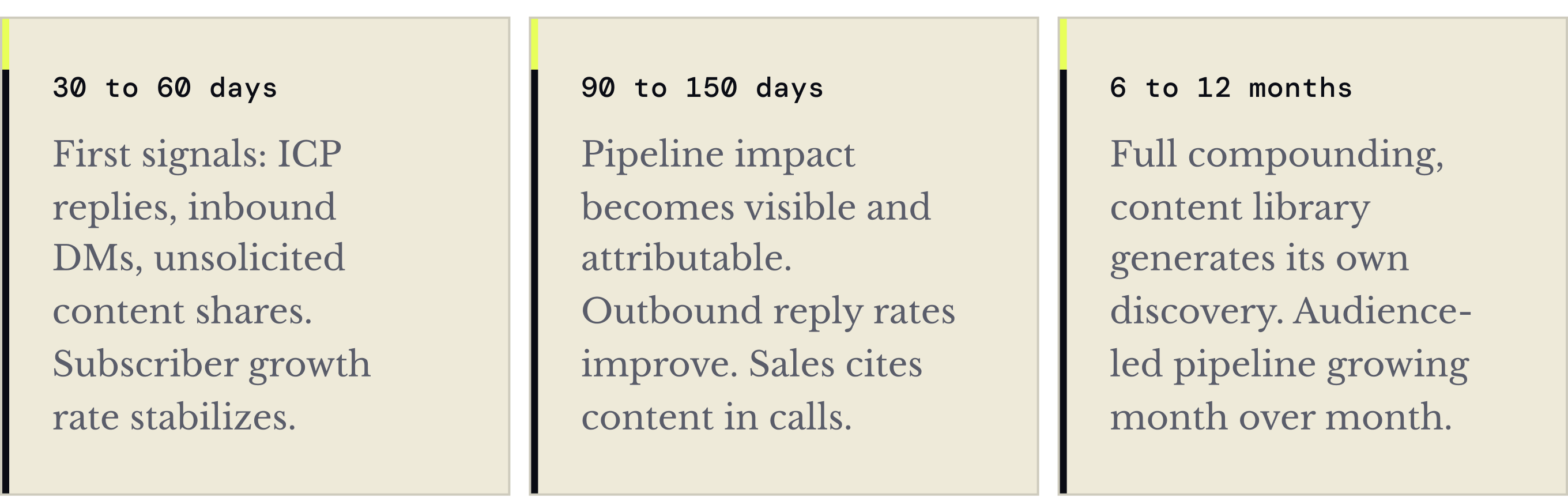
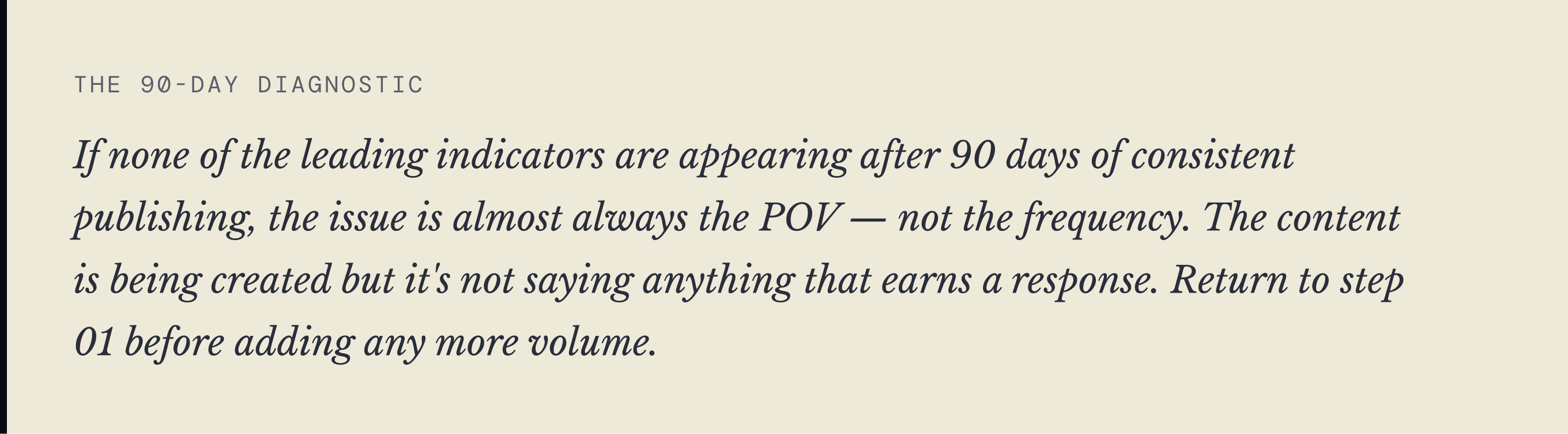
The leading indicators tell you the CTM system is working 60 to 90 days before it shows up in revenue. Track these first. Pipeline is the confirmation, not the signal.
Leading indicators
ICP open rate: Target 35%+ on a well-segmented ICP list. Trend matters more than absolute number. Flat or declining = POV problem, not frequency problem.
ICP click rate: Target 4%+ on a well-segmented ICP list. Clicks reveal which ideas actually move the reader off the page — opens prove the subject line, clicks prove the argument. Cluster the clicks by topic and you have your next editorial calendar.
Newsletter replies: Someone hitting reply is the single highest-signal B2B behavior. Even 1 to 2 per send in month one is a strong positive signal.
Inbound DMs citing content: Unsolicited references to specific pieces — this is language adoption. The category narrative is taking hold in conversations you can't see.
Subscriber growth rate: Month-over-month trend. Compounding subscriber growth means each week's content is generating its own discovery.
Linkedin ICP engagement: Acceptance rate on ICP connection requests is the cleanest top-of-funnel signal — it measures whether your profile and recent content earn a yes before you say anything. Target 40%+ on well-targeted requests, trending up quarter over quarter. Pair it with who's commenting — one VP of Engineering at your ICP is worth 50 random likes.
Shortlist appearances: Ask in every discovery call: "How did you hear about us?" Owned audience = being mentioned without an outbound touch.
Realistic timing
The market doesn't recognize you unless you built it
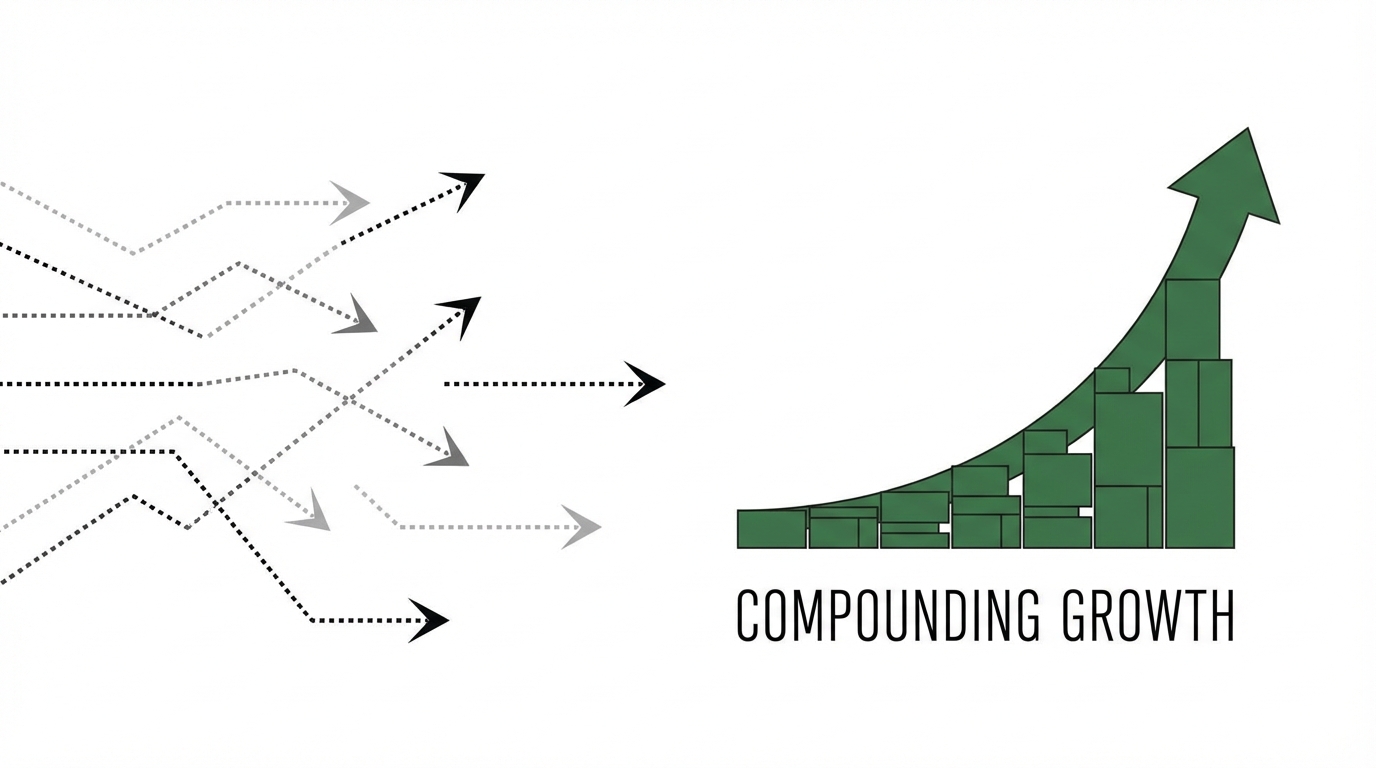
Going to market means going to a market that already exists. And you're going with a GTM motion identical to all your competitors. Same market plus same motion equals compounding noise.
Creating the market changes the math. It acknowledges the shift your product actually brings — a new way of thinking about a problem the category hasn't named yet. A unique POV and new category language isthe start. Engineering an audience around that thinking is your distribution moat — the thing that makes sure your message and your product stick when everyone else's bounces off.
GTM isn't broken. It's showing up late. CTM is what you add to your GTM so that you're making the rules and others are following.
Build in sequence. Start with the category problem. Everything else follows from getting that right.
.jpeg)

.png)