
.jpeg)
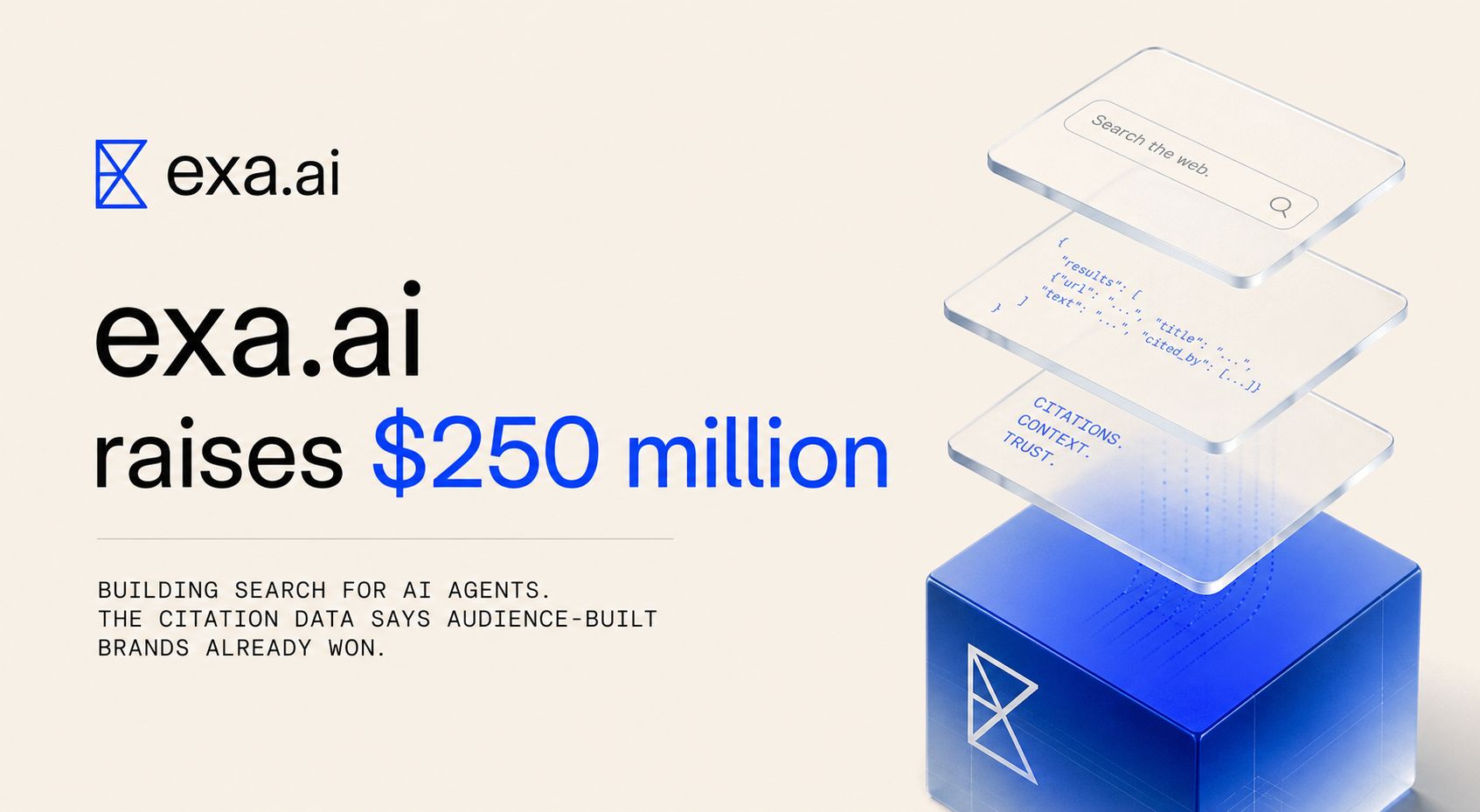
On Tuesday, a16z announced that it had led a $250M Series C in Exa Labs at a $2.2B post-money valuation. The valuation has more than tripled in nine months, up from roughly $700M last fall. The round is the largest single funding event in the AI-search infrastructure category to date.
Per Bloomberg's coverage via AI Weekly, Exa now serves over 100,000 developers. Exa's own customer wall features HubSpot and Devin directly. The product: search and web-retrieval APIs built specifically for AI agents rather than humans.
When the agents are doing the searching, the audience-engineering question stops being abstract. It becomes: when a buyer's AI agent goes looking for a vendor in your category, are you in the citation set or not?
HubSpot is the canonical customer quote.
Exa's published HubSpot testimonial puts the use case plainly: "Exa is necessary for agents on HubSpot to supplement internal data with high quality, real-time people and company search." HubSpot is the largest B2B marketing platform in the world. Its agents now run on top of Exa. The dependency runs upward, from the agent that needs to find a buyer to the search layer that surfaces who the buyer is.
The buyers of your product are about to be agents acting on behalf of humans. Agent-digestible content is going to win citation density. Human-only marketing collateral will not.
Which brings me to the part most operators are still missing.
Every distribution shift of the last five years has said the same thing, and the message is finally getting harder to ignore.
LinkedIn's algorithm changes told you to build an audience. The death of organic reach on every paid social platform told you to build an audience. The Google AI Overviews rollout told you to build an audience. The collapse of cold outbound told you to build an audience. The Exa funding round is just the latest receipt for the same argument.
Audience is not a marketing channel. Audience is the foundational GTM act. Everything else is downstream of whether you built one or not.
If you're a B2B operator reading this, the play is not complicated. It's just hard, and it takes longer than a quarter, which is why most operators avoid it. You build a public surface that compounds, on a channel you own, with a point of view that's actually yours. You do it consistently for 18-24 months before it produces compounding returns. Then it produces compounding returns for the next decade.
The companies that built that asset before the AI search shift didn't predict the future. They invested in the only GTM asset that doesn't depreciate. Everything else, including paid acquisition, including SEO, including the SDR org, depreciates the moment the next platform shift lands. The audience-built brand absorbs the shift and gets stronger.
That's the whole thesis behind Audience Engineer, and the Exa round is the latest reason it matters more, not less.
The citation data already says which brands win.
The thesis that audience-built brands get cited more by AI agents needs to be argued in two steps, because the data supports it through two distinct chains.
Step one: LinkedIn is the citation surface for B2B.
Profound's citation tracker documented LinkedIn climbing from approximately #11 to #5 among most-cited domains on ChatGPT between November 2025 and February 2026. That is the largest authority shift Profound observed across all sources tracked in 2025-26.
SEMrush's 325,000-prompt study found LinkedIn cited in 14.3% of ChatGPT Search responses, 13.5% of Google AI Mode responses, and 5.3% of Perplexity responses. For professional and B2B queries specifically, Profound found LinkedIn is the #1 most-cited domain across major LLMs.
Goodie's analysis of 5.7 million citation links across ChatGPT, Gemini, Claude, and Perplexity confirms the pattern: just 10 sources account for over 35% of all B2B SaaS citations, and LinkedIn is one of them.
This data establishes one thing and one thing only: LinkedIn is not a marketing channel anymore. It is the citation infrastructure that AI agents retrieve from when buyers ask B2B questions. That is a different argument than "audience-led companies win." It is the prior argument that makes the audience argument possible.
Step two: brand search volume is what predicts whether your brand gets cited.
The Digital Bloom's 2026 AI Visibility Report found that brand-search volume has a 0.334 correlation with LLM citations, outweighing traditional backlinks as a predictor. Brand search volume is what people type into Google when they already know your name. It is the most direct measure of whether you have built an audience that recognizes you.
First-party data and original research lift AI citations by an additional 30-40% on top of the brand-search baseline. Both signals reward the same thing: companies that built a public presence people talk about, refer to, and remember by name.
Putting the two steps together.
The citation surface is LinkedIn. The thing that determines whether you get cited within that surface is whether people know your name. Building an audience on LinkedIn is therefore the highest-leverage move in B2B GTM right now, because it does both jobs at once: it populates the citation surface, and it drives the brand recognition that determines who gets retrieved.
This is also why a company can be active on LinkedIn and still not get cited. Posting volume is not audience. A founder posting daily to an audience of nobody is not audience engineering. A founder posting weekly to an audience of 50,000 engaged operators in their category is. The platform matters. The audience inside the platform matters more.
The counter-argument worth naming.
Big brands with decades of Wikipedia entries, dominant SEO inertia, and constant third-party news coverage also crush LLM citations. Microsoft, Salesforce, and Adobe show up in agent retrieval not because they actively built audience engines in the audience-engineering sense, but because they accumulated mentions across the open web over 30+ years through traditional PR, analyst coverage, and SEO. The audience-engineering thesis is not the only way to be cited at scale.
Which is true, and it sharpens the actual claim. Among companies of similar size and category, the ones with audience-engineering moats get cited at materially higher rates than the ones without. RB2B gets cited at rates that 100x-larger competitors don't. Lavender gets cited above multi-billion-dollar sales-engagement platforms. Clay, beehiiv, and Linear sit above well-funded peers with bigger PR budgets and zero presence in the agent layer. If your company is not already a 30-year-old household name with a Wikipedia page, the audience-built path is the fastest way to enter the citation graph.
Amanda Natividad at SparkToro called this dynamic years ago in her Zero-Click Content framework. The thesis: when search results, social feeds, and now AI assistants serve answers in-place, the value of optimizing for clicks dies and the value of being citable rises. The Exa round is the infrastructure layer her thesis predicted, and the citation data is the receipt.
Jeff Hardison at Profound has been measuring this since 2025. His company exists specifically because brands now need to monitor what LLMs say about them when no human is in the loop. The 0.334 brand-search correlation is the kind of number Profound's product was built to surface.
What changes for B2B GTM specifically.
Three implications worth naming.
First: GEO (generative engine optimization) just stopped being a marketing-team experiment and became a board-level distribution question. When a meaningful share of buyer research happens inside agents, the citation density of your brand inside agent context windows becomes a top-of-funnel KPI. The companies that didn't invest in audience are about to find out what their citation graph looks like, and the answer for most of them is thin.
Second: paid acquisition's ROI just took another structural cut. Agents don't click ads. They don't open promoted posts. They retrieve, cite, and synthesize. Every dollar that was already losing efficiency in the LinkedIn algorithm shift is now losing efficiency in the agent retrieval shift too. The compounding cost of channel debt just compounded faster.
Third: the brand-search-volume number is the lever that matters. Profound, SEMrush, and Goodie all converge on the same input. Brand search volume predicts citation. Citation predicts agent visibility. Agent visibility predicts pipeline in a buyer journey where the buyer never types your name into Google because their agent already did the work.
The bottom line.
a16z's $250M check is the institutional confirmation of a thesis the audience-led operators have been running on for years. The retrieval layer is now a distinct, investable category. Agents are the new buyers. Citation density is the new SEO. The audience-engineering moat is now also the agent-retrieval moat. The companies that built audience before the AI search shift didn't get lucky; they were early. The ones who didn't are now competing for a slot in a citation graph they have no presence in, and the citation data already shows who is in it.
.jpeg)

.png)
.png)
.png)